“Do we need a full website, or can we begin with a landing page?”
It sounds like a question about size. A website has several pages; a landing page has one. A website costs more; a landing page is quicker. Those differences can be true, but they do not provide a reliable way to choose.
The better question is: what must this digital experience help a specific visitor understand and do?
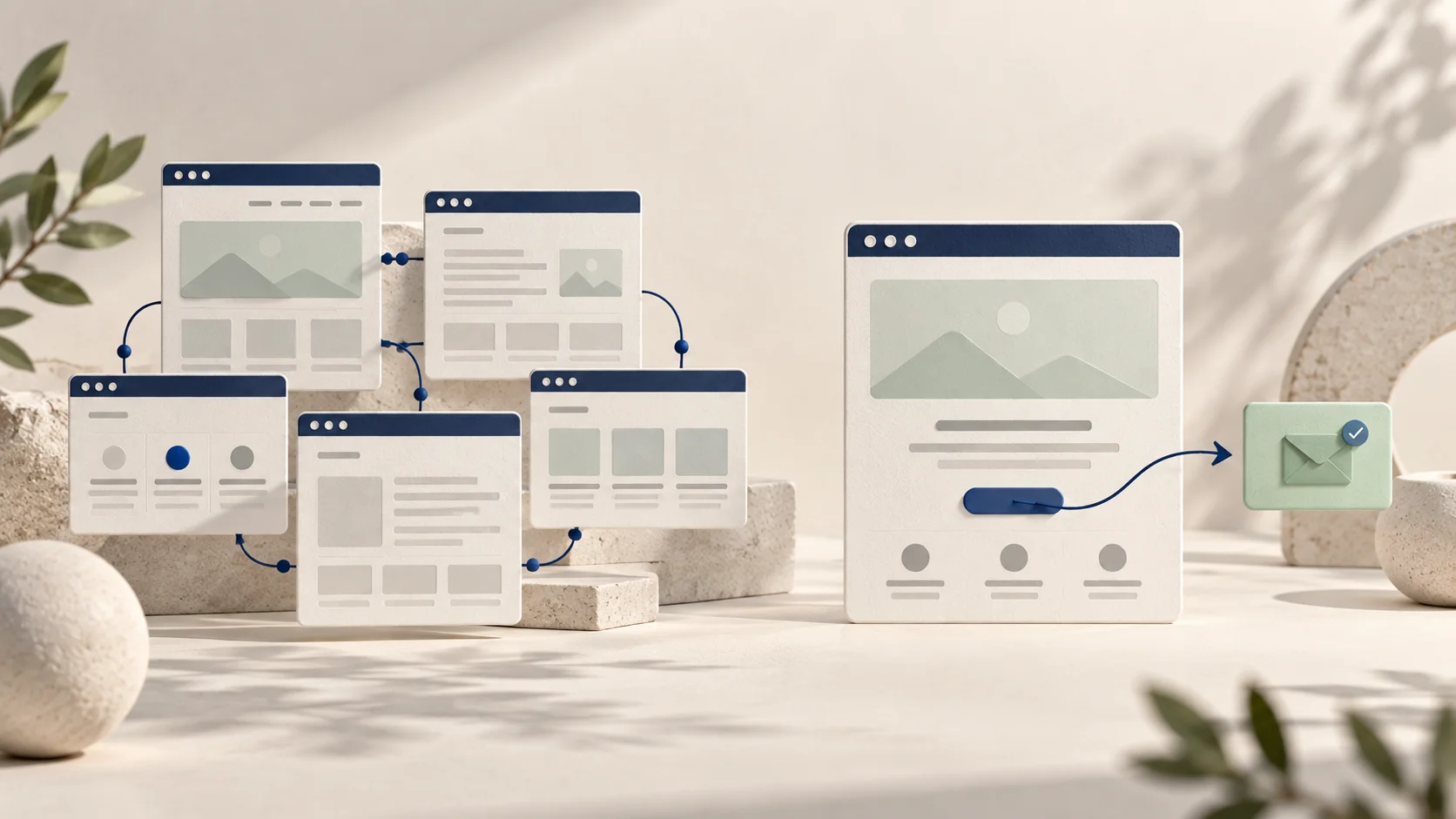
A website and a landing page serve different purposes. A website creates a broader, durable home for a business. It helps different kinds of visitors explore the company, understand several offers, assess its credibility and return for information over time. A landing page creates a focused path for one audience, one offer or one campaign. It removes unrelated choices so the visitor can consider a particular action.
Neither format is automatically more professional. A clear landing page can be more useful than a large but confusing website. A well-structured website can support trust and growth in ways that a single campaign page cannot. In many businesses, the right answer is eventually both—but each must have a defined job.
This guide explains the difference, shows where each format works well and gives you a practical method for deciding what your business needs now.
The short answer
Choose a website when people need to understand a business as a whole: its services, expertise, work, people, process and ways to make contact. It is usually the better foundation for an established business, a company with several services or audiences, and a long-term search and content strategy.
Choose a landing page when one particular group is arriving for one particular reason. It is often the better format for a paid campaign, event, product launch, programme, lead magnet, location-specific offer or a focused test of market interest.
Choose both when the business needs a credible permanent home and also runs focused campaigns. The website provides context and confidence. The landing page continues the promise made in the advertisement, email, social post or referral link.
Do not choose only by budget or page count. Choose according to purpose, audience, traffic source, buying decision and the next action you want someone to take.
A website and a landing page are not the same thing
A business website is a connected information system. It usually contains several routes because different visitors arrive with different questions. A prospective customer may begin with a service page, a potential employee may look for careers, an existing customer may need support and a partner may want company information. Navigation is useful because exploration is part of the experience.
A landing page is a focused destination. It is normally built around a defined message and a single primary conversion goal, such as requesting a consultation, registering for an event, downloading a guide or joining a waiting list. It may contain several sections and can be long, but every section should support the same decision.
This distinction is about purpose rather than the literal number of pages. A one-page business site with links to About, Services and Contact sections is still functioning as a website. A detailed campaign experience may use a confirmation page and supporting legal pages while still functioning as a landing page. Calling something a landing page does not make it focused; its content and journey must do that work.
Website vs landing page at a glance
| Consideration | Business website | Landing page |
|---|---|---|
| Main purpose | Explain the wider business and support several visitor needs | Move one audience toward one primary action |
| Typical audience | Customers, partners, candidates, media and existing clients | A defined campaign or offer audience |
| Traffic sources | Search, direct visits, referrals, social, campaigns and returning visitors | Paid advertising, email, social campaigns, QR codes or direct outreach |
| Navigation | Helps visitors explore several relevant paths | Limited so unrelated choices do not interrupt the journey |
| Content scope | Company, services, work, insights, team, contact and support information | One problem, one offer, relevant proof, key objections and one next step |
| Lifespan | Usually long term and continuously improved | May be temporary, seasonal, experimental or evergreen |
| Search role | Supports a broad search presence through useful page architecture | Can rank, but is often designed mainly for campaign traffic or one narrow intent |
| Measurement | Several meaningful actions across multiple journeys | A tightly defined conversion and its supporting steps |
What a business website does well
A website gives the business room to be understood beyond one offer. This is important when the buying decision involves research, comparison, internal approval or a meaningful level of trust. A visitor may need to see the service, review relevant work, understand the process, meet the team and read practical information before starting a conversation. A good website allows those questions to be answered in a deliberate order without forcing everyone through the same page.
It represents the whole business
If you offer four different services, work with several sectors or solve different problems, one campaign message is unlikely to explain the complete value of the business. A website can give each important service an appropriate home while maintaining one coherent brand and message.
This does not mean creating a separate page for every small capability. The structure should reflect how customers think about their needs. A strong service architecture helps visitors recognise the right starting point, compare relevant options and understand how services connect.
It supports trust over a longer decision
Some purchases cannot be reduced to a headline and a form. A company choosing a web partner, a manufacturer selecting a supplier or a family evaluating a specialist service will usually look for evidence. They may check past work, team information, address, policies, process, credentials and independent references across several visits.
A website can hold this evidence without making one page impossibly long. It also gives visitors control over their evaluation. They can move from a service to a case study, then to the company story and finally to the contact page when they are ready.
It creates a foundation for search and useful content
Search visibility usually requires more than publishing a homepage. Different searchers use different language and have different intentions. A structured website can provide useful pages for services, locations, customer questions, case studies and insights without forcing every topic into one document.
That does not mean more pages automatically create better SEO. Thin, repetitive pages can make the site worse. The value comes from creating distinct, useful resources connected by clear internal links. Over time, that structure helps people and search engines understand the subjects on which the business has genuine relevance.
It can serve more than prospective customers
A permanent website may also support recruitment, media enquiries, existing customers, partners and suppliers. These visitors should not dominate the customer journey, but they do need dependable routes to the right information. A landing page optimised for one sales action is rarely an effective home for all of those needs.
What a landing page does well
A landing page is most useful when attention has already been created elsewhere. An advertisement, email, presentation, social post or QR code introduces a specific promise. The page then continues that promise without asking the visitor to rediscover why they clicked.
Its strength is not that it is short. Its strength is that it is selective.
It creates message continuity
Imagine an advertisement for “landing pages for education admissions campaigns.” If the click goes to a general agency homepage covering branding, websites, content and advertising, the visitor must find the promised service for themselves. If the click goes to a page written specifically for admissions teams, the relevance is immediate.
The advertisement, headline, proof and call to action can use the same language. This continuity reassures the visitor that they reached the intended destination and reduces the mental effort needed to understand the offer.
It focuses one audience on one decision
A landing page removes material that may be true about the company but unnecessary for the immediate decision. It can focus on one audience’s situation, one offer, the most relevant evidence, the important objections and one action.
This does not mean hiding useful information or removing every link. Privacy, accessibility, company and contact information may still be necessary. It means that unrelated services and competing calls to action do not receive equal visual priority.
It makes a campaign easier to measure
When a page has a defined traffic source and goal, measurement becomes clearer. You can examine whether people view the offer, reach the proof, select the main action, begin the form and complete the enquiry. Different campaign messages can have distinct pages or controlled variations when there is a legitimate reason to test them.
Measurement still requires care. A conversion rate alone does not reveal lead quality, sales outcome or customer value. However, a focused journey makes it easier to identify where interest is being lost than a general homepage with many possible exits.
It can support a quick, controlled launch
A focused page may be appropriate when the business needs to validate demand before investing in a wider platform. An early-stage team can present one clearly defined offer, collect qualified interest and learn which questions people ask. An event organiser can publish essential programme and registration information without rebuilding the organisation’s main website.
Quick should not mean careless. The page still needs clear copy, reliable performance, accessible design, privacy information, working forms, appropriate tracking and a credible response process. A rushed landing page can damage trust as quickly as a rushed website.
What each format does poorly
Knowing the limitations is as important as knowing the strengths.
A website performs poorly when it behaves like an unedited company brochure. Too many pages, duplicate messages, unclear navigation and competing actions make exploration feel like work. Sending focused advertising traffic to a general homepage can also waste the precision created by the campaign.
A landing page performs poorly when it is expected to carry the permanent reputation of a complex business. If every service, audience, company detail, article and contact option is pushed into one continuous page, the supposed focus disappears. The visitor scrolls through a miniature website without the benefit of useful navigation or dedicated pages.
The question is therefore not “Which format is better?” It is “Which limitation is acceptable for this particular job?”
Nine factors that should guide the decision
1. The business goal
Begin with the result the page must support. “We need to be online” is too broad. A clearer goal might be to establish credibility for a new consultancy, generate enquiries for one service, register people for a workshop, present a product range or support a paid advertising campaign.
If the goal involves the overall business and will remain important over time, a website is likely to be the better foundation. If the goal is one bounded action connected to one offer, a landing page may be enough.
2. The number of meaningful audiences
Different audiences often need different evidence and language. A software company may speak to buyers, users, technical evaluators and job candidates. A college may serve students, parents, faculty and partners. Trying to address all of them in one conversion path usually produces vague copy.
A website can give these groups appropriate routes. A landing page works best when one primary audience is clearly defined. If you cannot complete the sentence “This page is specifically for…”, the landing-page brief probably needs more focus.
3. The complexity of the offer
A simple, contained offer can often be explained on one page. A service with several configurations, related capabilities, detailed specifications or a long buying process may need a broader information architecture.
Complexity should not be confused with word count. A landing page may need substantial detail for a serious decision. The issue is whether all of that detail supports one action. If the content begins serving several unrelated questions and visitor types, separate website pages will usually make it easier to use.
4. The traffic source
Traffic source changes the visitor’s context. A person typing the company name into search may want to explore the organisation. A person clicking an advertisement for one service expects the destination to continue that exact message. A returning customer may need support, not a sales pitch.
Websites accommodate mixed traffic. Landing pages are strongest when the source is controlled and its promise is known. Before choosing the format, write down where visitors will come from and what they will already understand before they arrive.
5. The buying cycle
If the decision can be made quickly with a small amount of information, a focused page may be sufficient. If the purchase involves several stakeholders, technical review, budget approval or significant risk, people will probably need a richer set of resources and more than one visit.
A landing page can still introduce a complex offer, but it may be only the entry point. The wider website, documentation, case studies and conversations continue the evaluation.
6. The proof available
Every format needs proof, but the amount and variety depend on the claim. A campaign page may need one relevant example, a clear process and answers to common objections. A business website may need a portfolio, case studies, team credentials, policies and multiple forms of evidence.
Do not add weak testimonials or invented results to fill space. If the business is new, demonstrate competence honestly through thoughtful explanations, transparent deliverables, sample work or the experience of the people involved.
7. The role of search
If long-term organic discovery is important across several services or questions, a website normally provides the stronger structure. It can develop useful topic clusters, connect insights to service pages and meet different search intentions with distinct content.
A landing page can appear in search, particularly for a narrow and useful subject, but it should not be treated as an automatic shortcut to rankings. Campaign pages written only by replacing a location or keyword can create thin duplication. Search value comes from relevance, usefulness and a technically sound experience, not from calling a page a landing page.
8. The operating capacity behind the page
A website is not finished at launch. It needs updates, technical maintenance, content ownership, security and periodic review. A landing page also requires ownership: the offer can expire, event dates change, forms break and advertising continues to send traffic long after a campaign has been forgotten.
Choose a format the team can maintain. A smaller, accurate website is better than a large site with outdated information. A campaign landing page should have an owner, launch date, review date and plan for what happens when the offer ends.
9. The next step after conversion
The page is only one part of the journey. If someone enquires, registers or downloads a resource, what happens next? Who responds? How quickly? What information is recorded? Is there a useful confirmation page and acknowledgement email?
A highly polished page cannot compensate for an unclear follow-up. Define the operational next step before designing the call to action. This also prevents the page from promising an experience the business cannot consistently deliver.
Realistic business scenarios
The following examples are illustrative. They are not client case studies and do not promise particular commercial results. Their purpose is to show how business context changes the choice.
Scenario 1: A new professional consultancy
A two-person operations consultancy has a clear service, a small collection of previous experience and plans to build relationships through referrals and LinkedIn. Prospective clients are likely to search the company name after hearing about it. They will want to understand the founders, the problems they solve, their working approach and how to begin.
A concise website is the stronger first investment. It may include Home, Services, About, Work or Experience, Insights and Contact. The site does not need dozens of pages, but it needs enough structure to support trust beyond one campaign. A single landing page could generate an enquiry, yet it would provide a weak destination for broader due diligence.
Scenario 2: A paid workshop campaign
A training company already has a website and is promoting a one-day workshop for finance managers in Hyderabad. The advertisement includes a specific date, subject and registration promise.
A dedicated landing page is appropriate. It can continue the exact campaign message, explain who the workshop is for, present the agenda, introduce the facilitator, answer attendance questions and lead to registration. Sending the traffic to the company’s general training page would make people search for the event and could dilute the message with unrelated courses.
Scenario 3: A manufacturer entering a new sector
An established manufacturer serves several industries and has a substantial corporate website. It is now promoting one specialised component to renewable-energy equipment companies.
The business needs both. The main website supports corporate credibility, technical capabilities, certifications and the full product range. A sector-specific landing page can speak directly to renewable-energy buyers, explain the relevant application and offer an appropriate technical enquiry. The landing page should link to supporting company information where it helps verification, without turning the campaign path into a second corporate website.
Scenario 4: A university admissions campaign
A university website must serve students, parents, faculty, researchers, alumni and administrative needs. Replacing that structure with one long page would be impractical. However, a campaign for one postgraduate programme has a defined audience and intake period.
The programme may deserve a focused admissions landing page containing the curriculum, eligibility, outcomes, faculty, fees, deadlines and enquiry or application action. The institutional website continues to provide accreditation, campus, policy and broader programme information. The landing page helps the campaign; it does not replace the institution’s digital home.
Scenario 5: An early-stage product idea
A founder wants to test interest in a narrowly defined subscription service before building the complete product. The audience, problem and proposed outcome are reasonably clear, but the business model is still being validated.
A landing page can be the right starting point if it is honest about the stage of the product. It can explain the intended value, show a credible concept and invite qualified people to join a waiting list or research conversation. It should not imply that unavailable features already exist. Insights from those conversations can later shape the product and a broader website.
Scenario 6: A multi-service creative agency
An agency offers brand strategy, websites, social content and performance marketing. It receives referrals for the company generally, while campaigns sometimes promote one service.
The agency needs a website that helps visitors understand each capability and how they connect. It can then use dedicated landing pages for focused campaigns such as “landing pages for new product launches.” Forcing the entire agency into one conversion page would oversimplify the business; sending every campaign to the homepage would make focused prospects work too hard.
What a strong business website should contain
Page names vary, but most service-business websites need to answer a consistent set of questions.
A clear homepage
The homepage should explain what the business does, who it helps and why the offer matters. It should provide clear routes rather than trying to contain every detail. The first screen needs enough specificity for the right visitor to recognise relevance, while the rest of the page can establish the offer, proof and next step.
Useful service pages
Each important service page should explain the situation in which the service is useful, who it fits, what is included, how the process works and what the visitor should do next. Service pages are decision tools, not only keyword targets.
Evidence
Relevant work, practical examples, results with honest context, credentials, process detail and real team information help a visitor evaluate the business. Evidence should sit close to the claim it supports. A generic portfolio separated from every service makes the visitor connect the dots themselves.
Company and people information
Visitors want to know who is responsible for the work. An About page can explain the point of view, experience and people behind the company without becoming an autobiography. For founder-led businesses, a clear and professional founder profile can be a strong trust signal.
Helpful insights and answers
Articles, FAQs and guides can answer questions that arise before an enquiry. They also demonstrate how the business thinks. Content should be written because it helps a real audience, with natural links to relevant services—not created simply to increase the number of indexed pages.
A dependable contact experience
The contact page should make starting a conversation feel straightforward. Ask only for information needed for a useful response, explain what happens after submission and provide appropriate alternative contact methods. Forms must be tested on mobile and monitored after WordPress, Elementor, theme or caching updates.
What a strong landing page should contain
A landing page needs fewer directions but not less thought.
Message continuity
The headline should continue the promise made before the click. If an advertisement addresses restaurant owners and offers a booking-focused website review, the landing page should not open with a general statement about digital transformation.
A specific audience and problem
The visitor should quickly recognise whom the page is for and which problem it addresses. Broad claims create more theoretical reach but less practical relevance. Specificity helps the right people continue and the wrong people self-select out.
A clear offer
Explain what the person receives, how it works, what is included and any important boundary. If the action is to request a consultation, describe what that conversation covers. If it is a download, show what the resource contains. Avoid using urgency or scarcity that is not real.
Relevant proof
Choose evidence related to the offer and audience. One well-explained project is often more persuasive than a wall of unrelated logos. When numerical outcomes are used, provide honest context about what was measured and avoid implying that every customer will receive the same result.
Objection handling
Address the questions that prevent action: suitability, process, timing, responsibilities, price approach, privacy or what happens next. An FAQ can help, but important answers should not always be hidden at the bottom of the page.
One primary call to action
The action should be specific and proportionate. “Discuss your admissions campaign” is clearer than “Submit.” Repeat it at sensible points on a longer page, but keep the label and destination consistent. Secondary links should support trust or accessibility without competing visually with the main goal.
A reliable confirmation
After the action, confirm that it worked. Explain the next step and expected response time accurately. For lead-generation forms, test notification delivery and store submissions securely so a failed email does not cause an enquiry to disappear.
Cost and timeline: what actually changes the work?
A landing page is often less expensive and quicker than a website because it has a narrower scope. That is a reasonable expectation, not a rule. A landing page connected to advertising, research, custom illustrations, complex forms, payment, CRM automation, multilingual content or controlled experiments can require significant strategy, design, development and testing.
Similarly, a focused five-page website can be more efficient than a single page overloaded with every message the business has. Page count is only one part of scope.
The main cost and timeline drivers include:
- clarity of the offer and audience;
- the amount of content strategy and writing required;
- number of distinct page templates or sections;
- custom photography, illustration or motion;
- forms, payments, booking systems and third-party integrations;
- migration of existing content;
- accessibility and performance requirements;
- analytics, consent and campaign tracking;
- number of stakeholder review rounds;
- testing across devices, browsers and user journeys;
- maintenance and optimisation after launch.
Ask for a scope based on the job the experience must do, not a price for “one page” versus “five pages” without context. A clear brief makes comparison more meaningful and reduces costly changes later.
The SEO difference between a website and a landing page
A website normally provides more opportunities to serve distinct search intentions. A service page can address a commercial need, a case study can demonstrate application and an insight article can answer an early research question. Internal links connect these resources and guide readers toward a useful next step.
A landing page can rank when it offers the best answer for a focused search, but many landing pages are primarily campaign destinations. They may rely on advertising, email, partner referrals or direct outreach rather than organic discovery. That is not a weakness if it matches the strategy.
Problems begin when businesses create dozens of nearly identical pages for keywords or locations, changing only a few words. Those pages provide little unique value and are difficult to maintain. If a location or audience genuinely changes the service, proof, process or practical information, a dedicated page may be useful. If it does not, strengthen one authoritative page instead.
Whichever format you choose, use a descriptive page title, one clear H1, useful headings, accurate metadata, meaningful internal links and accessible image alternatives. Make the content complete for the intended visitor rather than stretching it to reach an arbitrary word count.
Common mistakes to avoid
Treating a landing page as the permanent company website
A focused page can be a sensible starting point, but the business may outgrow it. If visitors increasingly need several services, team information, support, policies and educational content, continuing to add sections will make the page harder to use. Recognise when the temporary foundation needs to become a structured website.
Sending every campaign to the homepage
The homepage represents the whole business. It cannot always continue the specific promise of every advertisement. If a campaign targets one audience with one offer, create a destination that matches it closely.
Turning the landing page into a miniature website
Adding full navigation, every service, the complete company history, unrelated articles and several equal calls to action removes the focus that justified the landing page. Include what the decision requires and provide quiet access to essential company or legal information where appropriate.
Assuming fewer pages means less content work
Focused writing is not simply shorter writing. A strong landing page requires careful decisions about what to include, what to exclude and how to sequence the argument. It may require deeper customer understanding than a generic multi-page site.
Creating duplicate campaign pages without governance
When every campaign produces a new page, outdated offers, broken forms and inconsistent claims can accumulate. Maintain a page inventory with an owner, campaign source, launch date, review date and status after the campaign ends.
Measuring submissions but not business outcomes
A landing page can generate many low-quality leads. A website can produce fewer but better enquiries. Track the path from visit to qualified conversation and, where possible, to genuine commercial outcome. Respect privacy and collect only the data required for a defined purpose.
Forgetting what happens after the form
A conversion is not complete when a “Thank you” message appears. Confirm receipt, route the enquiry, respond within the stated timeframe and preserve the visitor’s context. The follow-up experience should feel like a continuation of the page, not a disconnected administrative process.
The combined model: a website plus focused landing pages
For many established businesses, this is the most useful long-term structure.
The website acts as the durable centre. It explains the company, organises services, presents work, publishes insights and supports broad discovery. Focused landing pages sit within or alongside that system for campaigns, events, launches, industries or particular offers.
The two should share brand standards, analytics governance, privacy practices and technical quality. They do not need identical layouts. A campaign page may remove the main navigation and use a more direct message, while still giving visitors access to essential company verification. The visitor should feel that both experiences belong to the same credible organisation.
This model also improves learning. Questions collected through a landing-page campaign can inform permanent service content. Strong website evidence can support the campaign page. The campaign does not become an isolated design exercise; it contributes to a more useful digital system.
A practical decision matrix
Use this table as a starting point, not an automatic rule.
| Your situation | Usually start with | Why |
|---|---|---|
| New service business that needs a credible long-term presence | Website | Visitors need to understand the company, offer, people and process |
| One paid campaign for one offer | Landing page | The message and action can match the campaign closely |
| Business with several services and customer types | Website | Different needs require clear routes and dedicated information |
| Event, webinar or limited intake | Landing page | Date, audience, programme and registration support one focused decision |
| Early validation of one product idea | Landing page | A controlled page can collect honest market interest before a larger build |
| Established company launching a focused campaign | Both | The landing page drives action; the website supports credibility and deeper research |
| Long-term content and organic-search strategy | Website | A structured set of useful pages can serve different search intentions |
| One-page site requested only to reduce cost | Reassess the goal | The cheapest format may not support the information or trust the decision requires |
Seven questions to answer before you choose
Write clear answers before requesting design or development:
- Who is the primary visitor? Describe the role, situation and level of awareness—not only age or location.
- What brought them here? Record the likely search, advertisement, referral, email or direct need.
- What must they understand? Identify the offer, problem, difference and essential proof.
- What is the primary action? Choose a realistic next step such as enquire, register, request a quote or join a waiting list.
- What information is required for confidence? List the examples, process, people, policies and answers needed before action.
- Will the content serve one focused decision or several distinct journeys? This is often the clearest indicator of landing page versus website.
- Who will maintain and respond? Assign ownership for updates, form submissions, measurement and follow-up.
If the answers describe several audiences, several goals and an ongoing need for information, build a website structure. If they describe one defined audience moving toward one defined action, build a landing page. If both are true at different levels, plan the website and campaign page as connected parts.
Frequently asked questions
Can a landing page replace a website?
It can temporarily replace a website for a very focused new offer, event or validation exercise. It is less suitable as the permanent digital home of a business with several services, audiences or information needs. The decision should be reviewed as the business grows.
Is a one-page website the same as a landing page?
No. A one-page website may contain the company’s general services, story, work and contact information for several types of visitor. A landing page is organised around one audience, one offer and one primary conversion. Purpose matters more than the number of URLs.
Do landing pages need navigation?
Not always. Removing the full site navigation can help a campaign remain focused, but visitors may still need access to privacy, accessibility, company and contact information. The correct choice depends on trust, regulation and the complexity of the decision. Do not remove useful routes merely because a template says landing pages should have no links.
Can a landing page rank on Google?
Yes, a useful landing page can rank for a relevant search. However, a thin campaign page is not automatically an SEO asset, and many landing pages are designed primarily for paid or direct traffic. If organic search is central to the strategy, plan content and site architecture beyond a single page.
Should advertisements link to the homepage?
They can when the campaign genuinely represents the whole business and the homepage continues the same message. For a specific service, audience, location, event or offer, a matching landing page will usually provide a clearer path.
How long should a landing page be?
Long enough to support the decision and no longer. A simple sign-up may need little explanation. A high-value professional service may require substantial proof, process detail and objection handling. Do not shorten useful content for appearance or add filler to imitate a competitor.
Can we begin with a landing page and build a website later?
Yes. Define the landing page as a deliberate first stage, use a domain and technical setup that can grow, and preserve what you learn from real enquiries. Avoid presenting the temporary page as a finished company platform if the information is incomplete.
Do we need both from the beginning?
Not necessarily. A new business may need a small website before it has a reason to run campaigns. An established business launching a specific offer may need a landing page immediately. Start with the format tied to the current goal, while keeping the longer-term system in view.
Choose the format around the decision
A website is not automatically better because it is larger. A landing page is not automatically better because it is focused. Each succeeds when its structure matches the visitor’s context and the business goal.
Use a website to create a dependable, expandable home for the whole business. Use a landing page to continue one clear promise and guide one audience toward one meaningful action. Use both when campaigns need focus and customers still need the confidence that comes from a complete digital presence.
Before deciding, define the audience, source, message, proof and next step. Once those are clear, the correct format is usually much easier to see.
Need help deciding whether your next project should be a website, landing page or a connected combination? Discuss your website with Nothing Down.