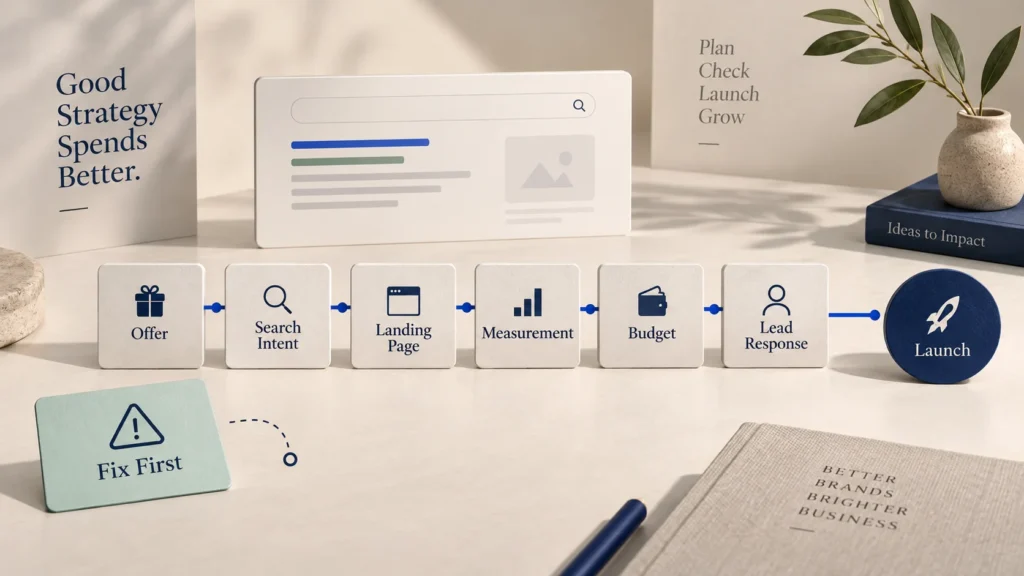

A business wants more enquiries, so someone suggests SEO. Another person recommends Google Ads. A third says both are essential. Soon, the discussion becomes a contest between channels instead of a conversation about what the business actually needs.
That is where poor marketing decisions begin.
SEO and paid advertising can both bring a business in front of people who are looking for something. But they work differently, solve different timing problems and depend on different foundations. Neither one can compensate indefinitely for an unclear offer, an unconvincing website or a team that does not respond properly to enquiries.
The useful question is not, “Which channel is better?” It is:
Which channel gives this business the most sensible next step, given its goal, urgency, demand, website, budget and ability to measure results?
This guide will help you answer that question without treating SEO as free traffic or paid advertising as an instant sales switch. It includes a practical comparison, readiness checks, realistic business situations, budget thinking, measurement guidance and three ways to sequence the work.
The short answer
Start with SEO when people already search for the problems, services or information you can address; your business needs durable visibility; you can invest in useful pages and technical improvements; and you can allow time for search engines and customers to respond.
Start with paid advertising when you have a clear offer, a defined audience, a suitable destination page, reliable tracking and a time-sensitive reason to create targeted visibility now. Paid campaigns can help a business test demand and reach relevant people quickly, but paying for traffic does not guarantee qualified enquiries.
Use both when short-term demand and long-term visibility matter at the same time—and when the business has enough budget and operational capacity to run both properly. Advertising can create controlled reach while SEO develops the pages, content and authority that support future discovery.
Before choosing either one, confirm that your website explains what you offer, whom it is for, why it should be trusted and what a visitor should do next. More traffic sent to a weak journey usually creates a larger version of the same problem.
SEO and paid advertising are not two versions of the same thing
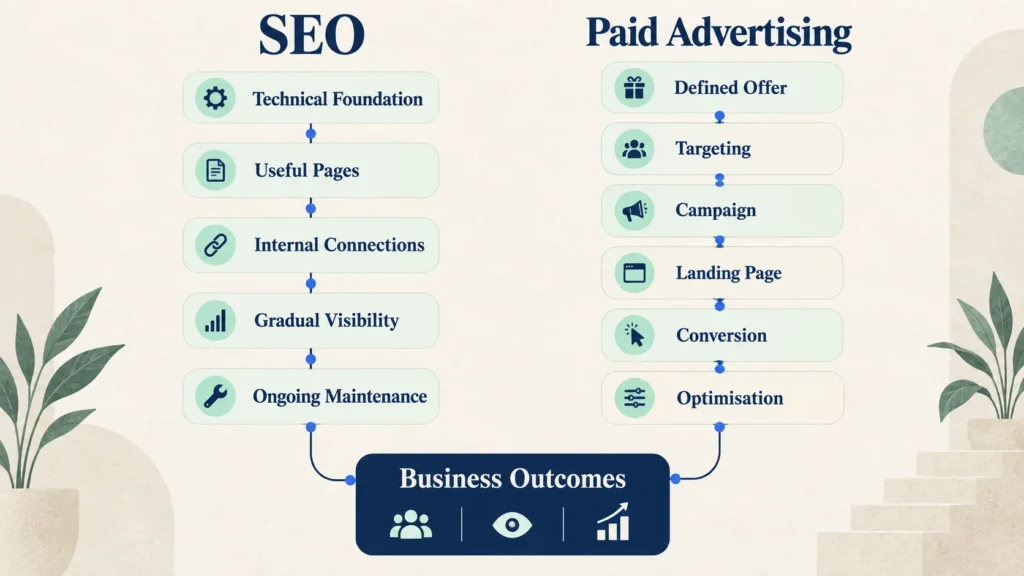
Search engine optimisation improves how easily search engines can discover, understand and present useful pages from your website. It includes technical accessibility, site structure, page quality, content, internal linking, local visibility and ongoing improvements based on real search behaviour.
Paid advertising buys access to selected placements and audiences under campaign rules. In paid search, an advertiser can target relevant queries, locations, devices and schedules, then bid or use automated bidding toward a chosen objective. Other paid channels may reach people based on demographics, interests, behaviour or previous interaction.
One builds assets and organic discoverability. The other purchases controlled distribution. They may appear on the same results page, but they are not the same system.
| Consideration | SEO | Paid advertising |
|---|---|---|
| Primary purpose | Improve organic discoverability and usefulness | Buy targeted visibility for a defined campaign goal |
| Speed of exposure | Usually gradual; changes may take time to be reflected | Campaigns can begin creating impressions after setup, approval and eligibility |
| Payment model | Investment in strategy, content, technical work and maintenance | Media spend plus strategy, setup, creative, management and landing-page work |
| Control | Less control over exact rankings and timing | More control over audience, location, schedule, budget and campaign message |
| Duration | Strong pages may continue attracting relevant discovery, but require maintenance | Traffic generally depends on campaigns remaining active and funded |
| Testing | Slower feedback, especially for new sites or topics | Faster message, keyword, audience and landing-page tests when sufficient data exists |
| Main dependency | Search demand, site quality, relevance, technical access and credibility | Offer, targeting, creative, bid/budget, landing page, tracking and follow-up |
| Common mistake | Publishing pages only to target keywords | Buying clicks before the conversion journey is ready |
| Best fit | Long-term, compounding visibility around real customer demand | Timely, controlled reach for a clear offer and measurable action |
The comparison is not “free versus paid.” SEO requires people, expertise, tools, implementation and time. Paid advertising requires more than media spend: it also needs strategy, creative, a conversion-ready destination and ongoing optimisation.
What SEO actually does
Good SEO helps the right pages become easier for both people and search engines to understand. That may involve correcting technical obstacles, organising services logically, answering useful questions, improving local business information, strengthening internal links and making each important page a better response to a particular need.
For example, a commercial interior business should not expect one general page titled “Our Services” to perform every search job. A person searching for an office fit-out partner, a retail interior specialist and a factory workspace designer may need different evidence, explanations and next steps. SEO work helps the business decide which distinct pages deserve to exist and what each page must contribute.
It also recognises that a visit is not the final outcome. A page can rank and still fail commercially if it makes the service difficult to understand. Search visibility and user clarity have to support one another.
SEO is not an instant ranking technique
There is no legitimate setting that makes a new page rank first on demand. Google’s own SEO guidance says that some website changes may be reflected within hours while others can take several months, and it generally recommends waiting a few weeks before assessing their effects. That does not mean every SEO project must wait months before any useful signal appears. It means a business should not build a forecast around immediate, guaranteed ranking movement.
SEO is also not a one-time collection of titles and keywords. Customer language changes. Competitors improve. Services evolve. Pages become outdated. Technical issues appear during redesigns and plugin changes. Useful SEO is maintained as part of the website, not applied once as a label.
SEO is not free traffic
Organic clicks do not carry a direct cost per click, but earning and maintaining useful visibility still has a cost. Someone must research demand, understand the business, plan pages, write and review content, implement technical changes, create evidence, improve local signals, monitor performance and update what becomes inaccurate.
Calling SEO free often causes underinvestment in the very work that makes it useful.
SEO is not keyword repetition
Repeating a phrase throughout an article does not make it the best answer. Search-focused content should be clear, original and written around the reader’s actual decision. If the page says “best digital marketing agency” twenty times but gives no reason to believe the claim, it has not become useful. It has only become repetitive.
What paid advertising actually does
Paid advertising gives a business a controlled way to enter selected moments of attention. A search campaign can place an eligible message near searches that suggest intent. A social campaign can introduce an idea to a selected audience. A remarketing campaign can reconnect with people who previously interacted with the business, where applicable and implemented with appropriate privacy and consent controls.
The strongest use of advertising is not “send everyone to the website.” It is to connect a particular audience, problem or search with a specific offer and next step.
Imagine a training company opening registrations for a programme that begins in six weeks. A paid campaign can support that immediate intake with controlled geography, message and budget. The destination page can explain who the programme is for, dates, outcomes, eligibility, fees and how to enquire. SEO may also support future intakes, but it may not be sensible to depend on a newly published page for an urgent six-week target.
Paid advertising is not a guaranteed lead system
An impression means the advertisement had an opportunity to be seen. A click means someone chose to visit. Neither proves that the person understood the offer, trusted the business, completed the form or became a suitable customer.
That journey depends on several connected parts:
- the intent or audience selected;
- the promise made in the advertisement;
- the relevance of the destination page;
- the clarity of the offer;
- the level of trust provided;
- the effort required to enquire;
- the accuracy of conversion measurement;
- the speed and quality of the business’s response.
Google Ads explains that ad position is not decided by bid alone. Its Ad Rank calculations also consider factors including auction-time quality, expected click-through rate, relevance and landing-page experience. That reinforces a wider point: a larger bid does not remove the need for a relevant message and useful destination.
Paid advertising does not buy organic rankings
Advertising and organic search should be planned together where useful, but buying advertisements does not purchase an organic ranking. Treat the two systems separately in reporting. A paid click is a paid click; an organic click is an organic click. One may inform the other through learning, but results should not be mislabelled.
Start with the business problem, not the channel
A channel decision becomes easier when the desired change is specific.
“We need more business” is too broad. Try to identify the real problem:
- We need enquiries for a defined service in two target cities.
- We need registrations before a fixed admissions date.
- Our website receives relevant traffic but visitors rarely enquire.
- Our business is difficult to find for non-branded local searches.
- We are launching an unfamiliar offer and need to test how people respond.
- Referral customers know us, but people discovering us online do not understand the difference.
- We depend on one lead source and need a more durable search presence.
Each problem creates a different starting point. If relevant traffic already exists but enquiries are weak, increasing traffic may be premature. If demand exists but the business is almost invisible, discovery may deserve priority. If the offer is new and the market language is uncertain, controlled testing may be valuable before a large content programme is built.
The nine factors that should decide where you start
1. Your immediate goal
Define one primary outcome for the first phase.
It might be qualified enquiries for a service, registrations for an event, calls from a local area, purchases of a defined product group or discovery of a specialist capability. The narrower the outcome, the easier it becomes to judge whether SEO, paid advertising or prerequisite work should come first.
SEO is often valuable when the goal is to become discoverable across a connected group of problems and questions. Paid advertising is often useful when a specific action and audience can be defined now.
2. The timeline
A fixed deadline changes the decision.
An admissions campaign, seasonal service or event cannot assume that a new page will earn meaningful organic visibility before the deadline. Paid promotion may be required for immediate controlled distribution. At the same time, businesses that face the same deadline every year should not restart from zero each time. The current campaign can be accompanied by evergreen pages and content that create a stronger base for the next cycle.
SEO should not be sold with a universal timeline. A technically healthy, established website updating an existing page is in a different position from a new domain entering a competitive national market. Scope, competition, authority, implementation speed and search demand all matter.
3. Existing search demand
SEO and search advertising work best when relevant demand can be identified.
Some customers search directly for the service: “commercial photographer in Chennai,” “ERP implementation company,” or “B.Pharmacy college near Tirupati.” Other offers are described internally with language customers rarely use. A business may call its service “operational clarity architecture” while customers search for “business process consulting.”
Research should examine both volume and meaning. A high-volume phrase may be too broad to produce suitable enquiries. A lower-volume phrase may represent a much stronger business need. The aim is not to collect the largest keywords; it is to understand how real people describe the problem at different stages of their decision.
When an offer is genuinely unfamiliar and search demand is limited, SEO may still help with education, credibility and adjacent problems, but demand creation through partnerships, social content, outreach or paid audience campaigns may also be needed.
4. Offer clarity
Advertising magnifies the message already present. SEO exposes the pages already created. If the offer is vague, both channels inherit the confusion.
Before investing heavily, the business should be able to answer:
- Who is this for?
- What problem or progress does it address?
- What is included?
- Why is this approach credible?
- What should an interested person do next?
- What happens after that action?
If the answers change every time someone on the team explains the service, clarify the offer first. The work in Before You Redesign Your Logo, Clarify Your Message is relevant beyond branding: channel performance also depends on a message customers can understand.
5. Website and landing-page readiness
The destination page must continue the promise made before the click.
A search advertisement for “warehouse automation consulting” should not send visitors to a general homepage where automation is mentioned in one sentence. An SEO page should not attract “website maintenance support” searches if it never explains what maintenance includes, who it serves or how support begins.
The page should provide:
- a clear first-screen explanation;
- a close match between the visitor’s need and the page;
- relevant proof, process or experience;
- useful answers to likely concerns;
- readable mobile presentation;
- an appropriate action with a clear label;
- a working form, call or booking journey;
- confirmation that the action was received;
- accurate analytics and conversion tracking where consent permits.
If traffic is already arriving but enquiries are limited, use Why Your Website Gets Visitors but Few Enquiries as a diagnostic before buying more reach.
6. Budget and economics
The relevant question is not simply, “How much can we spend?” It is, “What must be true for this investment to make business sense?”
For paid advertising, consider:
- media budget;
- campaign research and setup;
- creative or ad copy;
- landing-page creation or improvement;
- conversion tracking and testing;
- ongoing management;
- the cost of responding to and qualifying leads.
For SEO, consider:
- technical review and implementation;
- search and audience research;
- page planning and content creation;
- subject-matter review;
- design, development and internal linking;
- local or authority-building work where relevant;
- monitoring, maintenance and content updates.
A company should also understand approximate commercial economics: average order value, gross margin, lead-to-customer rate, sales-cycle length, repeat value and operational capacity. Without those numbers, a campaign may celebrate low-cost leads that rarely become suitable customers.
7. Measurement readiness
If the business cannot tell whether an enquiry came from a campaign, whether it was qualified or whether it became a customer, optimisation will be based on incomplete evidence.
Before launch, define the primary conversion. It might be a completed enquiry form, a verified phone call, a booked consultation or a purchase. Secondary signals—such as viewing a key page or clicking a button—can help explain behaviour, but they should not be reported as equal to a genuine lead unless that is truly the business outcome.
Google Ads’ current guidance requires a website data source and conversion actions to measure website conversions, and it advises checking that the tag is installed and reporting correctly. In practical terms: do not assume tracking works because code was added. Submit test forms, check confirmation paths, verify event status and prevent duplicate measurement.
8. Current visibility
Review what already exists before selecting a starting point.
The business may already rank for branded searches but have little non-branded discovery. It may receive organic visits from informational articles but lack service-page visibility. It may have run advertising before but never connected leads to sales outcomes. It may already have strong local visibility in one town and need a new approach for another region.
The decision should respond to that baseline. A business with useful organic traction may benefit from improving and expanding what works. A business with an urgent offer but no visibility may need a focused paid test alongside foundational SEO. A business with plenty of traffic and weak conversion may need neither channel first—it may need a clearer website journey.
9. The team’s operating capacity
Both channels require decisions after launch.
SEO needs implementation, expert input, updates and patient review. Advertising needs search-term or audience review, budget monitoring, creative improvement, lead-quality feedback and landing-page iteration. If nobody owns those actions, the campaign becomes a set-and-forget expense.
The sales or enquiry-handling team matters too. Paying to generate an enquiry that remains unanswered for two days is not a media problem. It is an operating problem.
Run a website-readiness check before spending
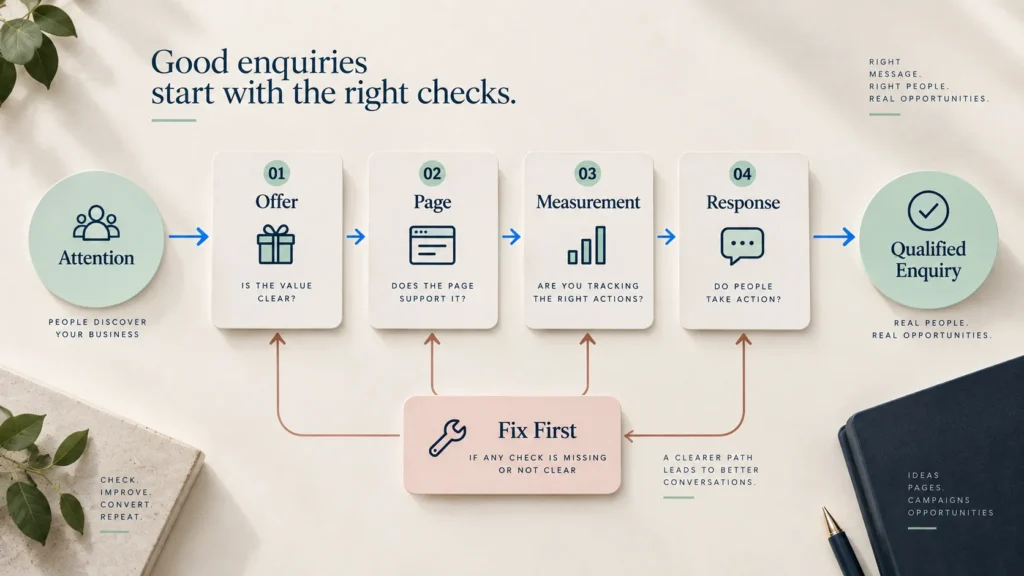
Ask someone unfamiliar with the business to open the proposed destination page on a phone. Give them ten seconds, then ask four questions:
- What does this business appear to offer?
- Who does the offer seem to be for?
- Why might someone trust it?
- What should a visitor do next?
If the answers are uncertain, the page is not ready to carry more attention.
Then complete a practical check:
| Area | Ready when… | Warning sign |
|---|---|---|
| Message | The offer and audience are immediately understandable | The headline could describe hundreds of unrelated businesses |
| Relevance | The page closely matches the query, ad or content promise | Everyone is sent to the homepage |
| Evidence | Appropriate work, process, qualifications or proof is present | Only unsupported claims such as “best” or “leading” appear |
| Mobile use | Text, buttons, forms and navigation work comfortably | Important content is cramped, hidden or slow |
| Action | One primary next step is clear | Several competing buttons have equal prominence |
| Form | Only necessary information is requested | The form feels like an application before trust is established |
| Confirmation | The visitor knows the enquiry was received | Submission produces no clear response |
| Measurement | Test conversions appear once and in the correct system | Events are missing, duplicated or counted as the wrong goal |
| Follow-up | A person and response standard are assigned | Enquiries wait in a general inbox without ownership |
If the intended campaign has one focused audience and one focused action, Website or Landing Page: Which Does Your Business Need? can help you choose the most appropriate destination. If the entire website still needs to be created, use What to Prepare Before Starting a Business Website before planning acquisition in detail.
When SEO should be the first major investment
SEO is a sensible first major channel when several of these conditions are present:
- customers already search for your service, product, category or problem;
- long-term discovery matters more than a short deadline;
- the business has useful expertise that can become strong pages;
- the website needs a clearer service and information structure;
- the organisation can implement technical and content improvements;
- the business wants to reduce dependence on campaign-only traffic over time;
- local visibility is important and business information can be managed consistently;
- the team can wait for evidence, review it and improve the work.
An established B2B manufacturer is a useful example. Buyers may search for specific capabilities, materials, certifications, tolerances or industries served. A strong SEO foundation may include capability pages, application pages, technical resources, clear enquiry paths and accurate company information. A broad advertisement saying “quality manufacturing solutions” cannot replace those assets.
SEO is especially valuable when the website itself needs to become a better explanation of the business. Even before ranking improvements are visible, the work can improve navigation, messaging and sales usefulness.
When paid advertising should be the first major channel
Paid advertising is a sensible first major channel when several of these conditions are present:
- there is a defined offer and a measurable action;
- relevant demand or a reachable audience can be identified;
- timing matters;
- the business has a campaign budget it can afford to test and learn from;
- a relevant landing page is ready;
- conversion tracking has been implemented and checked;
- the team can review lead quality, not only platform numbers;
- someone can monitor and improve the campaign;
- the business can respond to enquiries quickly.
Consider an education provider opening registrations for a programme with a specific start date. Paid search and social advertising may support immediate reach. But the campaign still needs a page that explains programme fit, schedule, outcomes, eligibility, location, fees or fee process, and the next step. If the destination cannot answer those questions, immediate traffic will not create immediate clarity.
Paid advertising can also be useful for learning. A controlled campaign may reveal which search language, problem statements or offers produce more qualified conversations. That learning can improve website and SEO priorities. However, early data should be treated carefully; a small number of clicks is not enough to declare a permanent market truth.
When the correct answer is both
SEO and paid advertising work well together when each has a clear responsibility.
For example:
- paid search supports urgent, high-intent service demand while SEO builds durable service and location pages;
- paid campaigns test two offer messages before the stronger learning informs permanent website copy;
- SEO articles answer research-stage questions while advertising promotes a timely consultation, event or offer;
- organic search expands long-term reach while paid remarketing—where appropriate—reconnects with previous visitors;
- advertising supplies immediate campaign data while Search Console and analytics reveal longer-term organic demand.
The useful relationship is not “do everything everywhere.” It is a connected plan in which both channels support the same commercial journey.
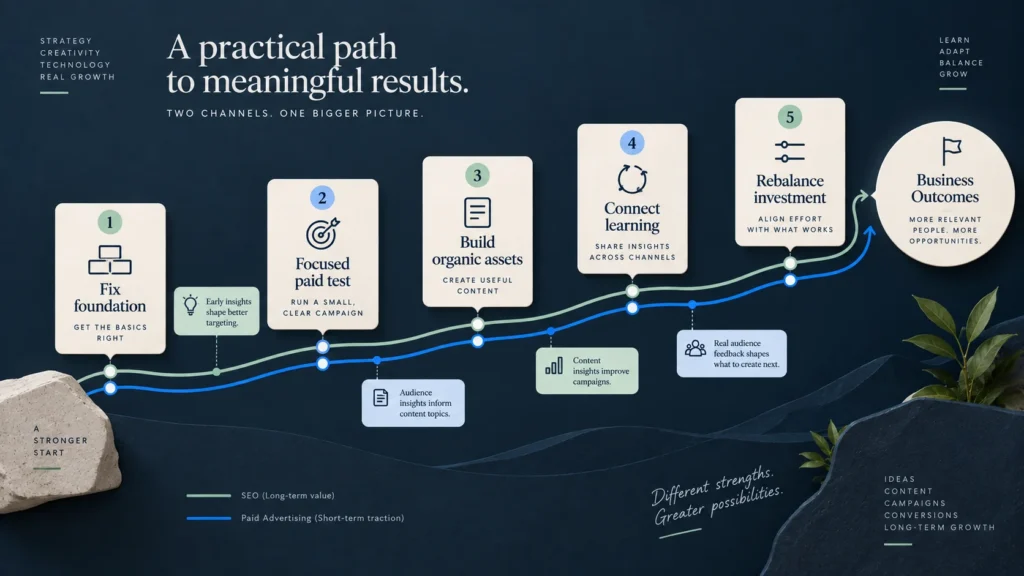
A phased combined approach
Phase 1: Fix the foundation. Clarify the offer, prepare the destination, implement measurement and establish a baseline.
Phase 2: Launch a focused paid test. Use a narrow audience or search theme, a controlled budget and one primary conversion. Review actual search terms, lead quality and page behaviour.
Phase 3: Build organic assets. Turn verified customer questions, service detail and search demand into strong permanent pages. Correct technical issues and strengthen internal navigation.
Phase 4: Connect the learning. Use paid-campaign language and enquiry feedback to improve SEO pages. Use organic query data to identify paid opportunities and exclusions. Keep reporting separated by source while sharing useful insights.
Phase 5: rebalance. Increase, reduce or redirect investment according to qualified enquiries, business value and capacity—not only clicks.
Four realistic starting situations
These are illustrative scenarios, not performance promises.
Scenario 1: A local emergency service
A local repair company serves customers who often need help immediately. Search intent is clear, response time matters and calls are valuable.
Recommended direction: begin with a tightly controlled paid search campaign for relevant service areas while improving local SEO, service pages, business listings and reviews. Route calls properly and measure qualified conversations. Exclude irrelevant searches as evidence develops.
Why: the immediate need suits paid search, while local organic visibility can reduce long-term dependence on campaign traffic.
Scenario 2: A specialist B2B manufacturer
The company sells a considered service with a long sales cycle. Buyers search by capability, material, application and compliance requirement. A lead may be valuable, but suitability matters more than volume.
Recommended direction: prioritise website structure, capability pages, technical content and organic search. Use selective paid search only for high-value, clearly understood terms or priority markets after the relevant pages and tracking are ready.
Why: buyers require evidence and detail. Broad traffic has little value if the website cannot demonstrate technical fit.
Scenario 3: A university programme with an admissions deadline
Applications close within a defined period. Students and parents search for programmes, eligibility, fees, outcomes, campus information and application steps.
Recommended direction: use paid campaigns for the active intake while strengthening programme pages, FAQs, structured internal links and evergreen admissions information for future cycles. Measure completed applications or verified enquiries separately from brochure downloads and page views.
Why: the deadline needs immediate reach, but repeating the same paid-only approach every intake wastes the opportunity to build a durable information base.
Scenario 4: A new consultancy with an unclear offer
The founder has broad experience and describes the service differently in every conversation. The website lists strategy, transformation, growth, innovation and advisory without defining a clear engagement.
Recommended direction: do not make either channel the first major spend. Clarify the audience, problem, offer, evidence and first engagement. Build a focused destination and measurement path. Then use a small paid test or a narrow SEO programme based on validated demand.
Why: more visibility would currently create more ambiguity. The bottleneck is positioning, not traffic.
How to think about budget without choosing an arbitrary number
A useful budget begins with a testable business model, not a round amount selected because it feels safe.
For paid advertising, work backwards:
- Define the primary conversion.
- Estimate what proportion of valid leads usually become customers.
- Understand the approximate value and margin of a customer.
- Decide what the business can reasonably invest to acquire one.
- Allow for campaign setup, creative, landing-page work and management—not only clicks.
- Set a test scope large enough to produce meaningful learning without risking money the business cannot afford to lose.
Do not promise a cost per lead before enough relevant evidence exists. Keyword estimates and previous account data may support planning, but actual results depend on the market, competition, quality, destination and sales process.
Google Ads uses average daily budgets, and its official documentation notes that daily spend can fluctuate above that average while remaining subject to billing limits. Anyone managing the account should understand the current budget rules instead of assuming the platform will spend the exact same amount every day.
For SEO, connect budget to the work required:
- Resolve serious technical obstacles.
- Improve pages closest to revenue or qualified enquiries.
- Build missing pages around verified customer needs.
- Strengthen local and organisational evidence where relevant.
- Publish only what the business can review and maintain.
- Reserve capacity for measurement and updates.
SEO investment should not be spread evenly across hundreds of low-value pages. Concentrate first on the parts of the website that help important customers understand and choose the business.
Measure the business journey, not only channel activity
Clicks, impressions and rankings help diagnose performance. They are not the final business result.
Useful SEO measures
- impressions for relevant non-branded and branded searches;
- clicks to priority pages;
- visibility for meaningful topics, locations and services;
- indexed and technically healthy priority pages;
- organic enquiry or purchase conversions;
- qualified lead rate by landing page;
- assisted journeys where organic discovery contributed;
- changes after content or technical improvements.
Do not report one ranking without context. Search results can vary, and one phrase may not represent the wider opportunity. Search Console query and page trends, conversion data and enquiry quality create a more useful view.
Useful paid-advertising measures
- spend and delivery against the approved scope;
- relevant search terms or audience quality;
- click-through behaviour as a diagnostic signal;
- conversion rate for the intended action;
- cost per valid or qualified lead;
- lead-to-customer rate;
- revenue or pipeline value where tracking is reliable;
- invalid, duplicate, irrelevant or uncontactable enquiries;
- landing-page performance by device and campaign.
A cheap lead is not efficient if the sales team cannot use it. A higher-cost lead may be commercially stronger if it is relevant, reachable and likely to become a suitable customer.
Shared business measures
Both channels should eventually connect to:
- qualified enquiries;
- response time;
- appointments or sales conversations;
- opportunities created;
- customers acquired;
- acquisition cost;
- revenue, margin or appropriate organisational value;
- customer quality and retention where relevant.
The connection may be difficult in a long or offline sales journey, but difficulty is a reason to improve measurement—not a reason to replace it with vanity metrics.
A practical 90-day starting plan
Ninety days is a useful operating window, not a promise that SEO or advertising will reach a particular result within that time.
If SEO is the priority
Days 1–30: understand and repair
- establish organic, conversion and technical baselines;
- identify priority audiences, services and search journeys;
- review crawling, indexing, templates, mobile use and internal linking;
- improve the most commercially important existing pages;
- define realistic measurement and reporting.
Days 31–60: build the missing foundation
- create or restructure essential service, location or topic pages;
- add useful evidence, process and FAQs;
- strengthen navigation and contextual internal links;
- improve local business information where relevant;
- publish only material that has been reviewed for accuracy.
Days 61–90: learn and expand carefully
- review early search and page signals without overreacting;
- correct weak snippets, unclear pages and technical gaps;
- develop the next content cluster from verified questions;
- connect organic conversions with lead-quality feedback;
- plan the next quarter based on evidence.
If paid advertising is the priority
Days 1–30: prepare the experiment
- define the audience, offer and primary conversion;
- build or improve the destination page;
- configure and test conversion measurement;
- research searches, exclusions, geography, schedule and devices;
- agree budget, responsibilities and lead-response process.
Days 31–60: launch narrowly and observe
- begin with a controlled campaign structure;
- inspect actual search terms or audience delivery;
- check conversion accuracy and duplicate reporting;
- review landing-page behaviour and enquiry quality;
- adjust obvious mismatches without making daily strategic reversals.
Days 61–90: optimise for quality
- compare campaign leads with sales feedback;
- refine messages, targeting, exclusions and page content;
- separate primary conversions from weaker signals;
- document useful customer language for website and SEO work;
- decide whether to scale, maintain, restructure or stop.
If both are priorities
Use one measurement plan and shared message, but give each channel its own role. Start paid advertising with a focused scope while the SEO team improves permanent pages. Hold a monthly review that combines search-term learning, organic queries, landing-page behaviour and lead quality. Do not combine paid and organic numbers into one total that hides what each investment produced.
Common mistakes to avoid
Choosing a channel before clarifying the offer
If the business cannot explain the value clearly, targeting tools will not solve the problem. Write the offer in plain language first.
Sending every advertisement to the homepage
The homepage serves several audiences and jobs. A focused campaign often needs a focused destination that continues the exact conversation started by the ad.
Running ads without verified conversion tracking
Clicks are not enough. Test the entire journey, check tag status, confirm that one action records once and distinguish genuine enquiries from secondary interactions.
Judging SEO after a few days
Search changes require time and context. Record what changed and when, then assess meaningful periods and multiple signals rather than reacting to daily movement.
Publishing thin pages for every keyword variation
Do not create near-duplicate pages that add no distinct value. Group needs where one strong page can serve them, and separate pages only when the audience, intent, service, location or information genuinely requires a different response.
Assuming the highest bid always wins
Paid-search auctions consider more than the bid. Relevance, expected performance and landing-page experience matter. Improve the complete experience instead of treating budget as the only lever.
Optimising for lead quantity without quality
The marketing platform cannot always determine whether a lead was suitable, reachable or commercially valuable. Feed real sales outcomes back into decisions.
Ignoring follow-up
If forms go to an unmonitored inbox, calls are missed or customers wait too long, acquisition spending leaks after the click. Assign an owner, response standard and simple lead-status process.
A simple decision matrix
| Your current situation | Sensible first direction |
|---|---|
| Clear urgent offer, ready landing page, verified tracking | Focused paid campaign |
| Strong expertise, real search demand, no urgent deadline | SEO foundation and priority content |
| Deadline now and recurring demand later | Paid campaign now plus SEO for the next cycle |
| Relevant traffic but few enquiries | Conversion and message improvements before more acquisition |
| New offer with uncertain language | Positioning and controlled validation before a large programme |
| Strong organic pages but a time-sensitive promotion | Paid campaign using relevant proven pages or a dedicated landing page |
| Heavy dependence on paid traffic | Build organic assets while protecting profitable campaigns |
| No tracking or enquiry ownership | Measurement and operating setup before scaling either channel |
This matrix is a starting point, not an automatic prescription. A short audit of the website, analytics, existing campaigns, search visibility and sales process should confirm the decision.
Questions to answer before approving the plan
- What exact business outcome should the first phase support?
- Is there a deadline?
- How do customers currently describe this need?
- Is there evidence of relevant search demand?
- Is the offer clear enough to advertise or optimise?
- Which page should the visitor reach, and why?
- Does that page work well on mobile?
- What proof or reassurance will the visitor need?
- What counts as the primary conversion?
- Has that conversion been tested from start to finish?
- How will lead quality be recorded?
- Who owns campaign or SEO improvements?
- Who responds to enquiries, and within what time?
- What budget and capacity can the business sustain beyond the first month?
- Which evidence would cause us to continue, change or stop?
If these answers are vague, the channel plan is not ready yet.
Frequently asked questions
Is SEO better than paid advertising?
Not universally. SEO is often stronger for durable discovery and a useful long-term website foundation. Paid advertising is often stronger for immediate, controlled distribution. The better starting point is the one that fits the business’s goal, timing, readiness and economics.
Should a new business start with SEO or Google Ads?
A new business should first clarify its offer, audience and conversion journey. If people actively search for the service and the website is ready, a focused paid-search test can create early learning while foundational SEO is developed. If the offer is complex, trust-heavy and not time-sensitive, strong website and SEO foundations may deserve priority.
How long does SEO take?
There is no responsible universal answer. Google states that some changes may be reflected within hours while others can take several months, and it suggests allowing a few weeks before assessing whether changes had a beneficial effect. The site’s history, competition, technical condition, topic, implementation and existing visibility all affect what happens.
How quickly can paid advertising work?
An approved and eligible campaign can begin creating impressions and clicks quickly, but business performance still depends on targeting, competition, budget, offer, page quality, tracking and follow-up. Immediate traffic should not be confused with immediate profit.
Does running Google Ads improve organic SEO rankings?
Paid and organic visibility are separate. Advertising can generate traffic and useful market learning, but it does not purchase an organic position. Report and evaluate the two sources separately.
Can a small business use both SEO and paid advertising?
Yes, but the scope should match its capacity. A small business may run one tightly focused campaign while improving a small number of priority pages. Doing fewer things properly is usually more useful than spreading a limited budget across many audiences, keywords and content topics.
Should ads go to the homepage or a landing page?
Use the page that best continues the visitor’s specific journey. A homepage may work for branded or broad company discovery. A focused campaign often performs more coherently with a dedicated landing page or highly relevant service page. The choice should follow the audience, promise and action—not a fixed rule.
What should be measured first?
Begin with one genuine business action: a valid enquiry, booked conversation, verified call, application or purchase. Then use impressions, clicks, rankings and page interactions to explain what helped or prevented that action.
The better first step is the one your business is ready to support
SEO and paid advertising are both useful. They become wasteful when chosen as substitutes for clear thinking.
SEO cannot rescue pages that say very little. Paid advertising cannot create trust after an irrelevant click. Neither channel can repair a slow enquiry process on its own. The work begins by identifying the business problem, clarifying the offer, preparing the destination and deciding how a real outcome will be measured.
Then choose the channel role:
- use SEO to build discoverability and useful permanent assets;
- use paid advertising to create controlled, timely reach;
- use both when the business can connect immediate learning with long-term growth;
- pause both when the offer, page, tracking or follow-up is not ready.
The objective is not to win an argument about marketing channels. It is to create a system in which the right people can find the business, understand the value and take a sensible next step.
Not sure whether SEO, paid advertising or website improvements should come first? Discuss your growth direction with Nothing Down. We will help you identify the clearest starting point.