The first click is not where a Google Ads campaign begins.
It begins earlier—when the business decides what it is offering, who should see it, which page should receive them, what action matters and how that action will be measured. If those decisions are missing, the campaign may still spend money. It simply will not know how to spend intelligently.
This is why a business can receive impressions, clicks and even form submissions while still feeling that Google Ads “did not work.” The platform delivered activity, but the commercial system around it was incomplete. The advertisement promised one thing, the page explained another, the conversion tracking counted button clicks as leads, and nobody recorded whether the enquiries were suitable.
Google Ads can create targeted visibility quickly. It cannot make an unclear offer clear after someone arrives. It cannot make an irrelevant landing page relevant. It cannot know that a lead was poor if the business never returns that information. It cannot repair a slow sales response.
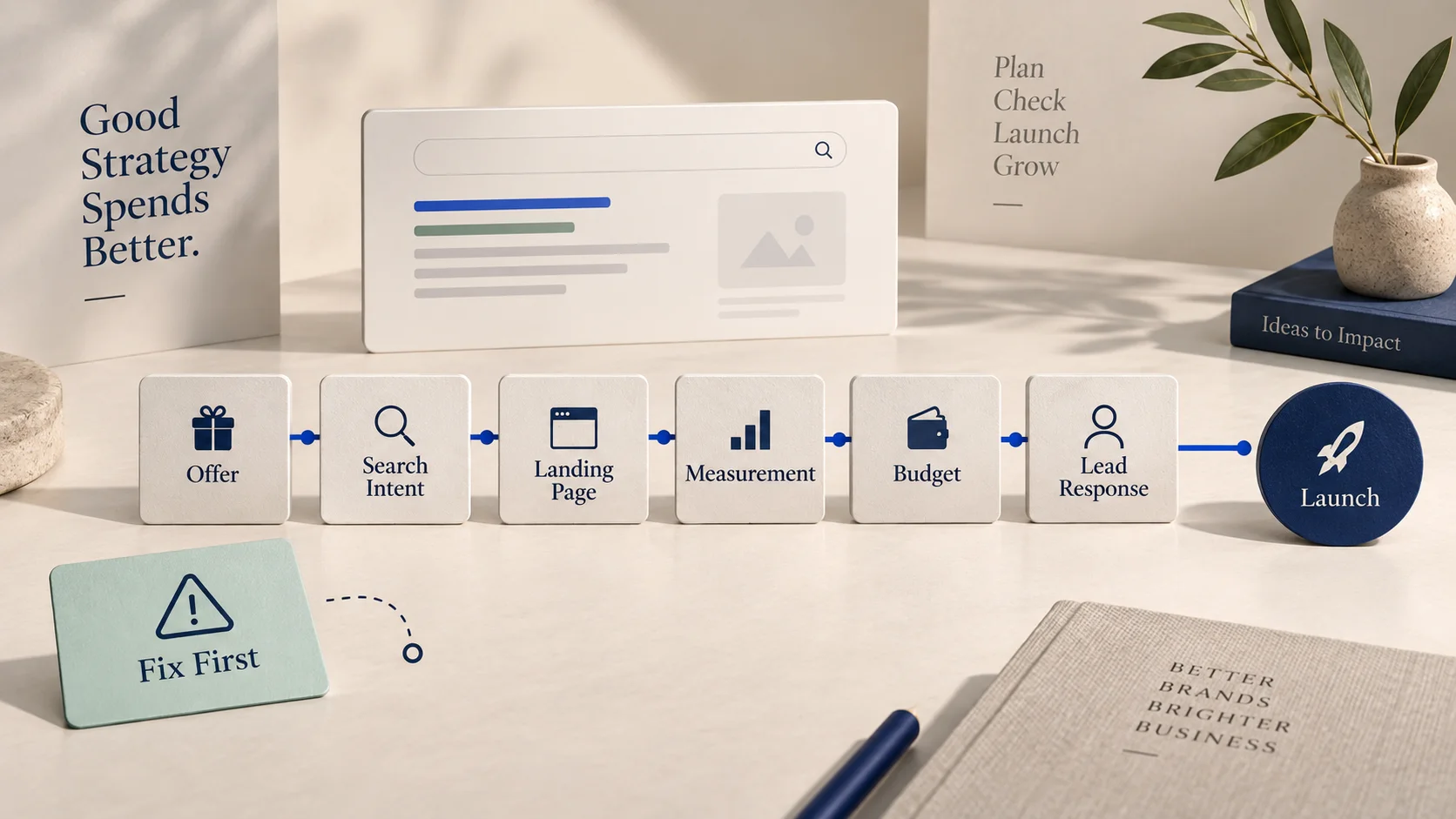
Before you approve a budget, complete the checks in this guide. Some are campaign settings. The more important ones are business decisions.
The short answer
Before spending money on Google Ads, confirm that you have:
- A specific business outcome—not only “more traffic.”
- A defined audience, geography and problem.
- A clear offer with honest, supportable claims.
- Evidence that people search for the need in a commercially useful way.
- The appropriate campaign type for the objective.
- A relevant, mobile-friendly landing page.
- One primary conversion that represents real value.
- Conversion tracking that has been tested from start to finish.
- A sensible keyword, match-type and negative-keyword plan.
- Location, language, schedule and device decisions that match the business.
- A budget based on economics and learning—not an arbitrary number.
- A person responsible for monitoring search terms, spend and lead quality.
- A fast, documented enquiry-response process.
- Clear rules for what will be changed, continued or stopped.
- Correct account ownership, billing access, security and privacy practices.
If the offer, landing page, conversion measurement or enquiry process is not ready, delay the campaign. Fixing those foundations is not avoiding advertising. It is protecting the advertising investment.
Google Ads is a distribution system, not a complete marketing strategy
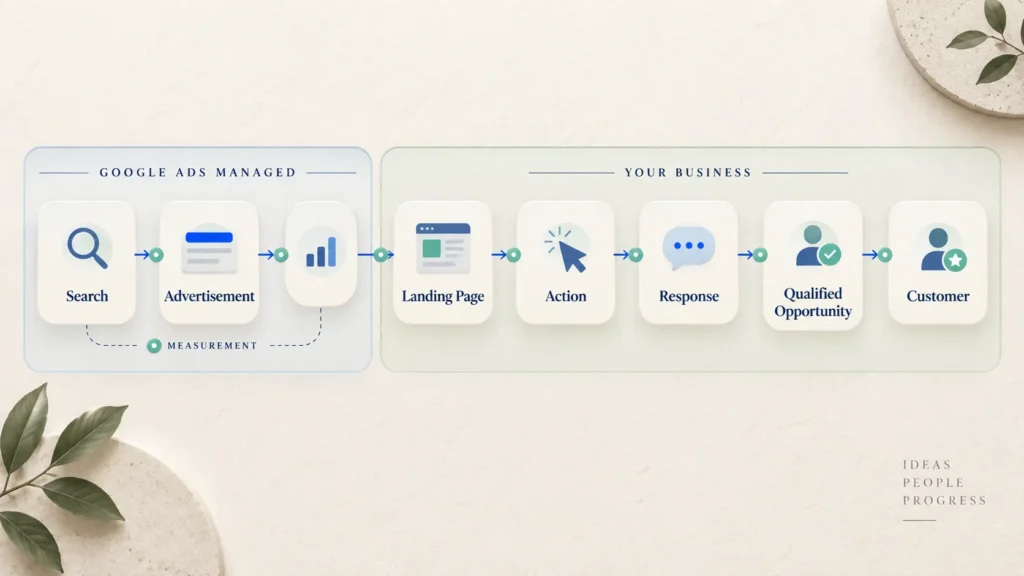
Google Ads helps an eligible advertisement enter selected auctions and reach people under campaign rules. It gives an advertiser meaningful control over budget, geography, timing, message and destination. But the platform operates inside a larger journey:
Search or audience signal → advertisement → landing page → action → response → qualified opportunity → customer
The campaign influences the early part of this journey. It does not own every part.
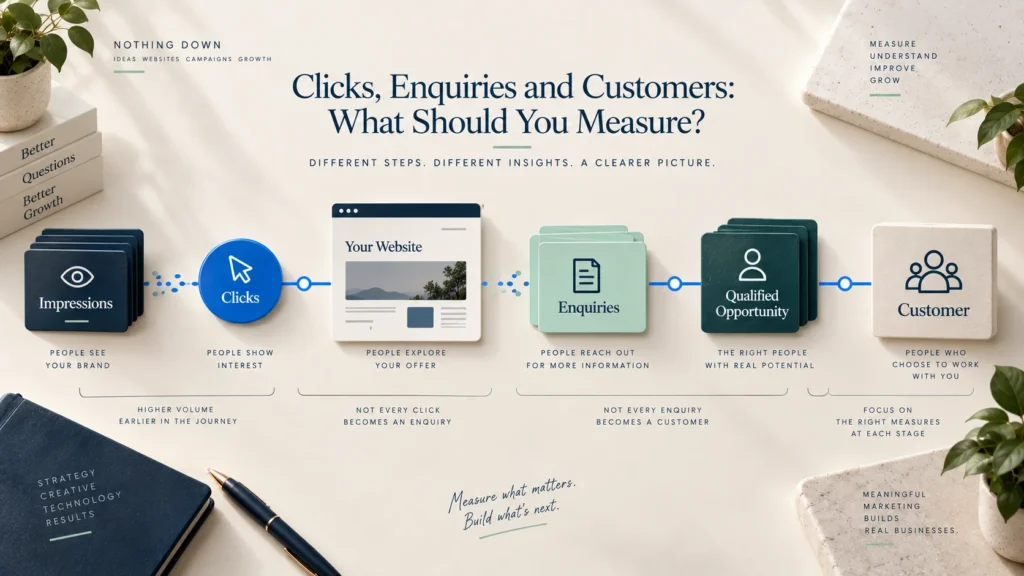
If people click but do not enquire, the problem may be the search intent, advertisement, page, offer or form. If enquiries arrive but rarely become customers, the problem may be qualification, price expectations, response time, sales handling or a mismatch between the campaign promise and the delivered service. If the tracking counts every WhatsApp button tap as a successful lead, the report may look healthier than the business feels.
That is why campaign performance should never be discussed only inside the Google Ads dashboard.
If you are still deciding whether paid advertising is the correct first channel, begin with SEO or Paid Advertising: Where Should Your Business Start?. This article assumes that Google Ads is being seriously considered and helps you decide whether the business is ready to launch it.
Check 1: Define the business outcome
“Get more clicks” is a platform objective. It is not a complete business objective.
A useful outcome is closer to:
- receive qualified enquiries for commercial website projects;
- generate calls for an urgent local repair service;
- increase applications for a programme before a closing date;
- sell a defined product group within serviceable locations;
- book consultations for one specialist service;
- generate demo requests from a particular type of organisation.
The outcome determines the campaign structure, page, conversion action and reporting. A campaign built for phone calls should not be evaluated like an ecommerce campaign. A B2B service with a six-month decision cycle should not be judged only by immediate purchases.
Write the objective in one sentence
Use this format:
We want [specific audience] in [location] to take [meaningful action] for [defined offer] during [relevant period].
For example:
We want operations managers at manufacturing companies in the Chennai–Sri City corridor to request an initial consultation about a clearly defined workflow-automation assessment during the next eight weeks.
This sentence is not campaign copy. It is an internal decision filter. It helps the team reject unrelated keywords, audiences and promises.
Define what is not a success
A B2B agency may not consider student job enquiries, vendor pitches or requests outside its service region successful. A college may distinguish completed applications from brochure downloads. A clinic may separate general calls from booked appointments, subject to the privacy and advertising rules that apply to its sector.
Write down exclusions before launch. Otherwise, the campaign may optimise toward actions that are easy to generate but commercially weak.
Check 2: Make the offer specific enough to advertise
Google Ads puts the business beside a customer’s immediate question. Vague offers struggle in that environment.
Compare these two messages:
We deliver innovative digital solutions for tomorrow.
Website strategy, design and development for service businesses that need clearer enquiries.
The second is not perfect for every campaign, but it gives the customer something concrete to evaluate. The first asks the customer to interpret what “digital solutions” might mean.
Before launch, answer:
- What exactly can the customer enquire about or buy?
- Who is it for?
- Which situation makes it relevant?
- What is included in the first step?
- What makes the approach credible?
- Which locations can the business genuinely serve?
- Are there minimum order, eligibility, timing or scope conditions?
- What happens after the enquiry?
Check whether the promise can be supported
Do not advertise “guaranteed first position,” “instant results,” “number one,” “lowest price” or other absolute claims unless they are lawful, accurate and supportable. Even when a claim passes platform review, it can still weaken trust if the website gives no evidence.
Use specific proof instead of inflated adjectives:
- the type of projects completed;
- a transparent process;
- relevant experience;
- service-area clarity;
- genuine qualifications or certifications;
- authorised testimonials or reviews;
- clearly explained deliverables;
- realistic response or delivery information.
The message work discussed in Before You Redesign Your Logo, Clarify Your Message applies here too. Advertising should amplify a clear offer, not become the first place the business tries to invent one.
Check 3: Understand the customer’s search intention
A keyword is not merely a phrase with a search estimate. It represents a possible situation.
Someone searching “what is CRM automation” may be learning. Someone searching “CRM automation company Chennai” may be evaluating providers. Someone searching a company name may already know whom they want. These searches can all matter, but they should not automatically share the same advertisement, landing page or expected conversion rate.
Group research by intent:
| Intent | Typical situation | Suitable campaign response |
|---|---|---|
| Learning | The person is understanding a problem or category | Education, guide or selective awareness strategy |
| Comparing | The person is evaluating approaches, providers or costs | Clear differentiation, evidence and decision support |
| Acting | The person is ready to enquire, call, book or buy | Focused offer and low-friction conversion path |
| Navigating | The person is searching for a known brand or website | Brand protection or direct destination where appropriate |
| Employment or education | The words resemble the service but the need is unrelated | Exclude or separate where not relevant |
| Existing-customer support | The person needs help, login or contact information | Route correctly rather than count as acquisition |
Do not treat volume as value
A broad term may attract many searches and still be a poor commercial starting point. “Marketing” has enormous semantic range. “B2B manufacturing lead generation agency” is narrower but communicates a more defined situation.
Start with relevance and the ability to serve the need. Use volume and estimated cost as planning inputs—not as proof that a phrase will produce customers.
Interview the people who handle enquiries
Ask the sales or customer-facing team:
- What words do customers use?
- Which questions appear just before an enquiry?
- What misunderstandings create poor-fit leads?
- What types of requests should not enter the pipeline?
- Which service names are internal jargon?
- What proof do serious customers ask for?
This language is often more useful than a large keyword export without business context.
Check 4: Choose the campaign type deliberately
Do not choose a campaign type because the interface recommends it first or because another business uses it.
Different campaign types offer different combinations of inventory, targeting, automation, creative requirements and visibility. Search campaigns can respond to search behaviour. Performance Max can distribute across multiple Google inventory sources using goals, assets and signals. Shopping depends on product and Merchant Center foundations. Video and Demand Gen address different attention environments.
The correct choice depends on:
- the objective;
- whether demand already exists;
- the available creative assets;
- the quality of conversion data;
- the level of control and transparency required;
- the product or service model;
- ecommerce feed readiness where applicable;
- the budget available for meaningful learning;
- the team’s ability to manage the campaign.
For a small service business running its first campaign, one focused Search campaign may be easier to understand and diagnose than a broad multi-channel setup. That is not a universal rule. It is a reminder to keep the initial system explainable.
Ask what the campaign must learn
The first campaign may need to learn which search themes produce qualified enquiries, which locations respond, which offer language is understood or which page resolves doubts. Choose a structure that makes those questions visible.
If the structure mixes several services, locations and conversion goals immediately, the business may spend money without knowing what caused the result.
Check 5: Prepare the correct landing page
The landing page is where advertising turns into an experience.
If an advertisement says “Commercial Website Development for Manufacturers,” the destination should continue that exact conversation. A general homepage that begins with “We Transform Possibilities” forces the visitor to search again after already clicking.
The page should answer seven questions
- Am I in the right place?
The heading should match the need and promise that brought the visitor. - Is this for a business like mine?
Name the audience, situation, location or fit where appropriate. - What exactly is being offered?
Explain the service, product or first engagement in concrete terms. - Why should I trust this business?
Provide relevant proof, process, work, experience or credentials. - What will happen next?
Explain the enquiry, call, assessment, purchase or application process. - What might stop me?
Address important questions about scope, eligibility, timing, location or commitment. - How do I act?
Use one clear primary action with an appropriate amount of form friction.
Test the page on a real phone
Do not only shrink a desktop browser. Open the page on several actual mobile devices or reliable emulation profiles and test:
- loading and layout stability;
- headline visibility;
- text size and line length;
- button and field usability;
- keyboard behaviour;
- form validation;
- telephone and WhatsApp actions where used;
- confirmation after submission;
- sticky elements covering content;
- errors on slow or unstable connections.
Use the homepage only when it is genuinely the best destination
A homepage can suit branded discovery or a broad company enquiry. A focused campaign usually benefits from a focused service page or landing page. Website or Landing Page: Which Does Your Business Need? explains how to choose according to the visitor’s decision rather than a fixed design rule.
If your website already receives traffic but produces few enquiries, diagnose it with Why Your Website Gets Visitors but Few Enquiries before paying for more visitors.
Check 6: Decide what a real conversion is
The campaign needs one primary outcome that represents real progress.
For a service business, this may be a completed enquiry form, a qualified phone call or a booked consultation. For ecommerce, it may be a purchase with value. For an education campaign, it may be a completed application or a verified admissions enquiry. A brochure download can be useful, but it should not automatically carry the same importance as a completed application.
Separate primary and secondary actions
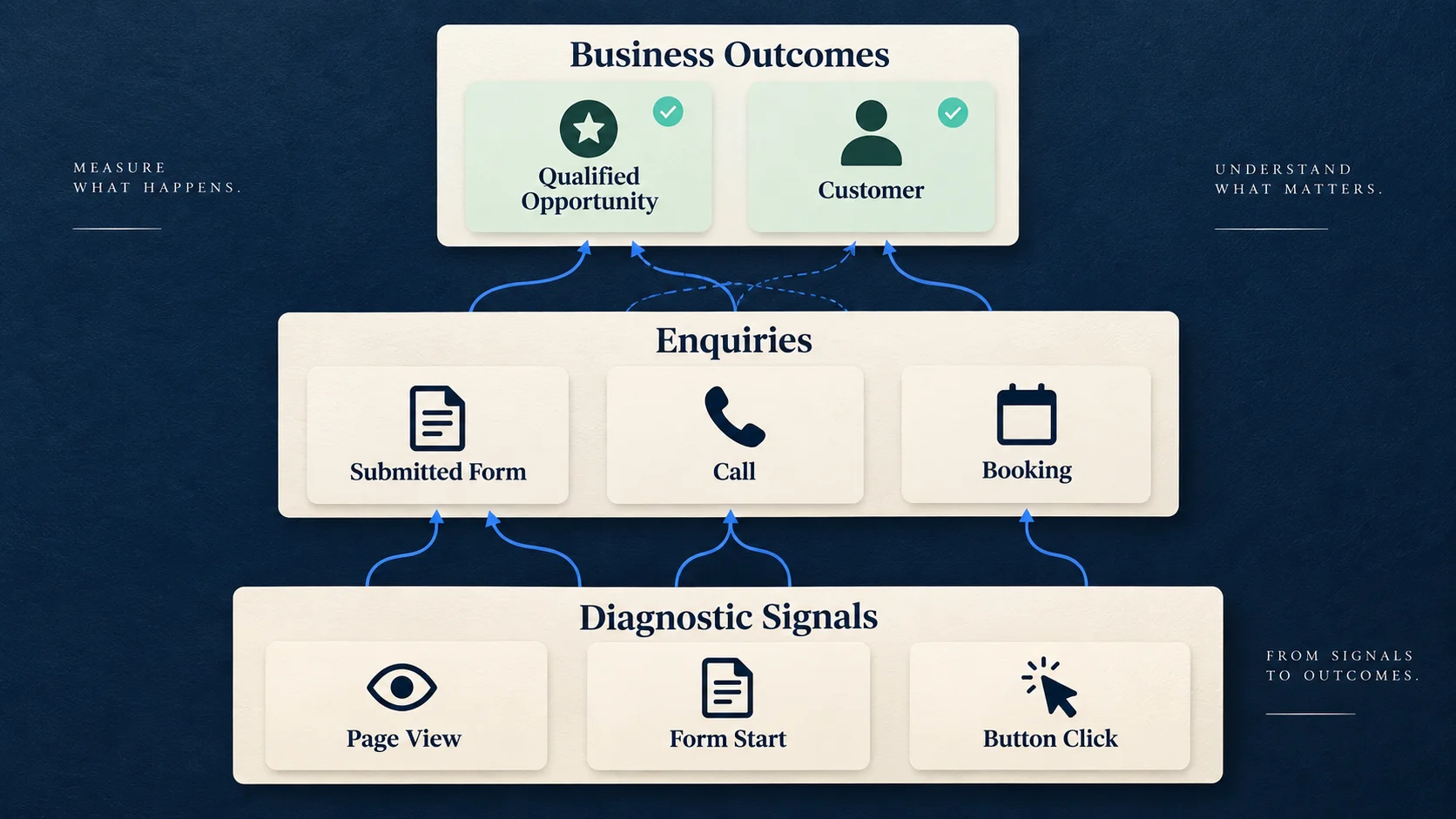
| Action | Possible role | Important caution |
|---|---|---|
| Completed enquiry form | Primary conversion | Confirm it reaches the right person and excludes spam where possible |
| Verified phone call | Primary conversion | Define a meaningful duration or qualification method carefully |
| Purchase | Primary conversion | Pass accurate value, currency and transaction identifiers |
| Booked consultation | Primary conversion | Confirm booking completion, not only calendar-page views |
| WhatsApp button click | Secondary signal until verified | A click does not prove a message was sent or qualified |
| Email link click | Secondary signal | The user may not complete or send an email |
| Brochure download | Secondary or micro-conversion | Interest is not the same as an application |
| Key-page view | Diagnostic signal | Do not report it as a lead |
| Form-start event | Diagnostic signal | Useful for friction analysis, not a completed enquiry |
Google Ads distinguishes Primary conversion actions, which can be used for bidding, from Secondary observation actions. The campaign should not optimise toward every easy interaction simply because it can be tracked.
Write a conversion dictionary
For every measured action, record:
- event name;
- plain-language definition;
- trigger condition;
- primary or secondary role;
- count method;
- value method where relevant;
- owner;
- test evidence;
- destination in analytics, Ads and CRM;
- known limitations.
This small document prevents reporting arguments later.
Check 7: Install and test conversion measurement
Tracking is not complete when someone says, “The tag has been added.” It is complete when the business performs the action, confirms the event appears once in the correct systems and verifies that the resulting lead or transaction can be followed appropriately.
Google’s current web-conversion setup supports URL-based measurement for simple page loads and code-based methods for actions such as button clicks, dynamic values or transaction IDs. Its documentation also warns that CMS plugins can accidentally double-tag a site, which can produce duplicate conversion reporting.
Test the complete journey
Before launch:
- Open the page as a new user.
- Accept or reject consent choices as applicable and confirm expected behaviour.
- Complete the form, call, purchase or booking action.
- Verify the browser confirmation.
- Confirm the enquiry reached the correct inbox, CRM or system.
- Check that the conversion event appeared once—not zero times and not twice.
- Confirm the correct category, name and primary/secondary setting.
- Verify value, currency and transaction ID where applicable.
- Test mobile and desktop.
- Repeat after major website, form, plugin or tag changes.
Avoid counting page refreshes as new leads
If a thank-you URL fires a conversion every time it loads, refreshing or revisiting it may inflate the numbers unless implementation and counting are designed properly. Restrict access where appropriate, use event logic or transaction identifiers when necessary, and test repeated behaviour.
Plan for offline outcomes
For many businesses, the valuable outcome happens after the form: the lead is contacted, qualified, quoted and eventually becomes a customer. A campaign that optimises only to form submissions cannot distinguish a serious project from an irrelevant request unless downstream information is connected.
At minimum, maintain lead statuses such as:
- new;
- contacted;
- valid;
- qualified;
- proposal or application stage;
- won or completed;
- lost;
- invalid, duplicate or spam.
The system can become more advanced later. The first requirement is that someone records the truth.
Check 8: Protect privacy and collect only what you need
Advertising measurement may involve cookies, device information, form data, phone calls, audience lists or customer information. The correct implementation depends on the business, user location, campaign type and applicable law.
Before launch:
- publish an accurate privacy policy;
- explain how enquiry information is used;
- collect only fields required for the next step;
- obtain appropriate consent where required;
- review tag and audience behaviour against user choices;
- limit access to customer and advertising data;
- avoid placing sensitive information in URLs or event names;
- set appropriate retention and deletion practices;
- ensure vendors and plugins are reviewed;
- obtain qualified legal advice where risk or regulation requires it.
Do not copy another website’s cookie banner or privacy language without checking whether it describes your actual setup.
Check 9: Plan keywords, match types and negative keywords
In Search campaigns, the keyword list is not a list of every phrase the business hopes to appear for. It is a steering system.
Google currently provides broad, phrase and exact keyword matching options. These do not work as literal mechanical filters. Exact match can include searches with the same meaning or intent, phrase match can include searches that carry the keyword’s meaning, and broad match can reach additional related searches using contextual signals.
That makes the search-terms review essential.
Build themes around one intent
Keep each ad group or equivalent theme understandable. Keywords grouped together should be able to share:
- a common customer situation;
- a relevant advertisement;
- the same destination page;
- similar conversion expectations.
If “brand identity design,” “social media management” and “website development” all share one ad and page, the message will become generic.
Start with a negative-keyword hypothesis
Potential exclusions depend on the business, but common categories to investigate include:
- jobs, careers, internships and salaries;
- courses, definitions or tutorials;
- free, template or download intent;
- DIY or software-only needs;
- irrelevant product types;
- locations the business cannot serve;
- customer-support and login searches;
- unrelated meanings of the same word;
- competitor names when strategy or policy does not support them.
Do not copy a giant universal negative list. A word that is irrelevant for one business may be valuable for another. Review each exclusion in context, and remember that negative keyword matching behaves differently from positive matching.
Review the search-terms report
Google’s search-terms report shows searches that triggered advertisements and helps advertisers see how keywords matched actual demand. Use it to:
- identify irrelevant searches;
- discover useful customer language;
- refine match types and themes;
- add justified negatives;
- find new landing-page questions;
- investigate high-spend queries without meaningful outcomes;
- compare search intent with lead quality.
The report may not expose every single query. Work with the available data and do not claim complete visibility.
Check 10: Configure location, language, schedule and devices consciously
Location targeting is more nuanced than selecting a city name.
Google Ads can use both physical location signals and areas in which a person has shown interest, depending on campaign settings and available options. A hotel may value people outside the destination who are planning a visit. A local emergency electrician may care much more about people physically present within a serviceable radius.
Before launch, document:
- locations included;
- locations excluded;
- whether presence, interest or another available location option fits the use case;
- where the business can actually deliver or respond;
- language of the advertisement and page;
- call-centre or team availability;
- days and hours that deserve coverage;
- whether mobile callers receive a usable experience;
- whether regional pricing, eligibility or regulations differ.
Do not confuse user location with serviceability
A searcher may be interested in a location without being there. The platform’s inferred location is not identical to a confirmed service address. If serviceability matters, confirm it during the customer journey.
Align the schedule with response capacity
If the campaign encourages urgent calls but no one answers evenings or Sundays, either adjust coverage or establish a reliable follow-up system. The cheapest click at 2:00 a.m. is not valuable if the enquiry expires before morning.
Check 11: Write advertisements that pre-qualify, not only attract
The best advertisement is not necessarily the one that earns the most clicks. It is the one that creates the right expectation for suitable people.
A useful Search advertisement should connect:
- the customer’s need;
- the defined offer;
- an honest reason to consider it;
- relevant conditions such as audience or location;
- the next action;
- a destination that fulfils the promise.
Use specificity to improve fit
If a service is designed for manufacturers, say so. If the business serves only certain locations, make that visible where appropriate. If the first step is a paid assessment rather than a free consultation, do not hide that difference until after the click.
Pre-qualification can reduce raw click volume while improving business usefulness.
Prepare complete, accurate assets
Depending on campaign type and eligibility, additional assets may include sitelinks, call information, structured details, images, locations or other formats. Every asset should lead to a useful destination or action. Do not add links merely to fill space.
Google explains that Ad Rank uses more than bid. Auction-time quality can include expected click-through rate, ad relevance and landing-page experience. The practical lesson is straightforward: budget cannot permanently compensate for a disconnected advertisement and page.
Check 12: Build a budget around learning and economics
There is no responsible universal daily budget for Google Ads.
The appropriate amount depends on the market, objective, estimated costs, conversion rate, commercial value, campaign scope and how much uncertainty the business can accept. A budget that is adequate for one local service may produce too little information in a competitive national B2B market.
Calculate the full investment
Include:
- advertising media spend;
- campaign research and setup;
- landing-page design or improvement;
- writing and creative production;
- tracking implementation and testing;
- management and optimisation;
- CRM or call-tracking systems where appropriate;
- enquiry handling and sales time;
- ongoing page and creative improvements.
Work backwards from customer economics
Use known business figures where possible:
- Average customer or transaction value.
- Gross margin or contribution after delivery costs.
- Lead-to-customer rate.
- Time required to close.
- Repeat or lifetime value where evidence exists.
- Maximum acquisition investment the business can sustain.
If these figures are unknown, label them as assumptions and build the first campaign partly to improve understanding. Do not present an invented target cost per lead as a guarantee.
Understand average daily budgets
Google Ads uses average daily budgets. Its official guidance explains that daily spend may fluctuate above the average on some days while billing-period limits apply. The person approving the campaign should understand those rules and monitor actual spend rather than assuming the exact same amount will be spent every day.
Give the test enough room—but define a loss limit
A budget that buys only a few clicks may not answer a meaningful question. A large budget without tracking and decision rules can waste money faster. Define:
- the approved test amount;
- the expected time window;
- what can be changed during the test;
- a stop condition for broken tracking, irrelevant traffic or policy problems;
- the review date;
- the evidence required before scaling.
Check 13: Prepare the enquiry-handling system
Advertising can reveal operational weaknesses that referrals previously hid.
A referral lead may wait because they already trust the introducer. A search lead may contact several providers and choose the clearest, fastest relevant response.
Before launch, define:
- where forms, calls and messages arrive;
- who owns each channel;
- the expected response time;
- what happens outside working hours;
- how duplicates and spam are handled;
- the questions used to qualify a lead;
- how source and campaign information is retained;
- which statuses are recorded;
- how sales feedback reaches the campaign manager.
Improve the first response
“We received your enquiry” is useful confirmation, but the human follow-up should also help the customer progress. It can acknowledge the stated need, ask only essential next questions and explain what will happen next.
Do not automate a promise the team cannot keep.
Record why leads fail
Use clear reasons:
- outside service area;
- wrong service;
- employment enquiry;
- budget mismatch;
- no response after follow-up;
- duplicate;
- spam;
- timing not suitable;
- selected another provider;
- qualified but not yet decided.
Without this information, “poor leads” becomes an opinion rather than evidence.
Check 14: Establish reporting and decision rules before launch
The report should answer a business question, not display every available metric.
Campaign diagnostics
- impressions and eligible reach;
- search terms or audience delivery;
- clicks and click-through behaviour;
- spend and pacing;
- conversion actions and rates;
- location, device and schedule patterns;
- landing-page performance;
- policy or serving issues.
Business outcomes
- valid enquiries;
- qualified enquiries;
- response time;
- appointments or sales conversations;
- proposals or applications;
- customers or completed outcomes;
- acquisition cost where data is reliable;
- revenue, margin or pipeline value where appropriate;
- reasons for invalid or lost leads.
Define review rhythm
Some checks are operational and should happen frequently, especially after launch: spend, disapprovals, broken pages, tracking and obviously irrelevant search terms. Strategic conclusions need enough evidence. Changing the goal, targeting, message and bidding every day makes the test impossible to interpret.
Use a decision log:
| Date | Observation | Evidence | Change | Expected effect | Review date |
|---|---|---|---|---|---|
| Example | Employment searches appearing | Search-terms report and invalid leads | Add reviewed job-related negatives | Reduce irrelevant traffic | Seven days later |
This prevents the team from repeating changes or confusing correlation with cause.
Check 15: Secure account ownership and access
The business should own its advertising assets even when an agency or freelancer manages them.
Before spending:
- create the account under a business-controlled identity;
- give partners appropriate access rather than sharing passwords;
- enable strong authentication;
- confirm billing ownership and payment method;
- document the customer ID and linked properties;
- verify access to Analytics, Tag Manager, Merchant Center and Business Profile where relevant;
- remove access when a relationship ends;
- maintain more than one trusted administrator without creating uncontrolled access;
- keep change history available;
- avoid placing critical assets only inside an individual employee’s personal account.
Ask the manager to explain the campaign in plain language. The business should be able to see what is running, where traffic goes, what is measured and how money is being used.
A complete pre-launch scorecard
Do not score this by instinct. Ask for evidence.
| Area | Ready evidence | Not ready signal |
|---|---|---|
| Objective | One audience, offer, action, geography and period are documented | “We need more traffic” |
| Offer | Scope, fit, proof and next step are clear | Broad list of unrelated services |
| Search intent | Themes reflect real customer situations | Keywords chosen only for volume |
| Campaign type | Choice is linked to objective and available assets | Chosen because it was recommended by default |
| Landing page | Mobile-tested page matches the ad promise | All traffic goes to a vague homepage |
| Conversion | Primary and secondary actions are defined | Every click is treated as a lead |
| Tracking | Test action appears once in Ads/Analytics and reaches the business | Tag installed but not verified |
| Privacy | Policy, consent and data access reflect the real setup | Copied banner or unclear collection |
| Keywords | Themes, match types and initial exclusions are documented | Large unreviewed keyword export |
| Geography | Included, excluded and presence/interest logic are reviewed | City selected without serviceability check |
| Ads | Claims are accurate and pre-qualify the visitor | Generic superlatives designed only for clicks |
| Budget | Approved test, full costs and decision points are clear | Arbitrary daily amount with no loss limit |
| Lead process | Owner, response standard and statuses exist | Enquiries enter a general inbox |
| Reporting | Platform and business outcomes are connected | Success equals impressions or clicks |
| Access | Business controls accounts, billing and administrators | One external person owns everything |
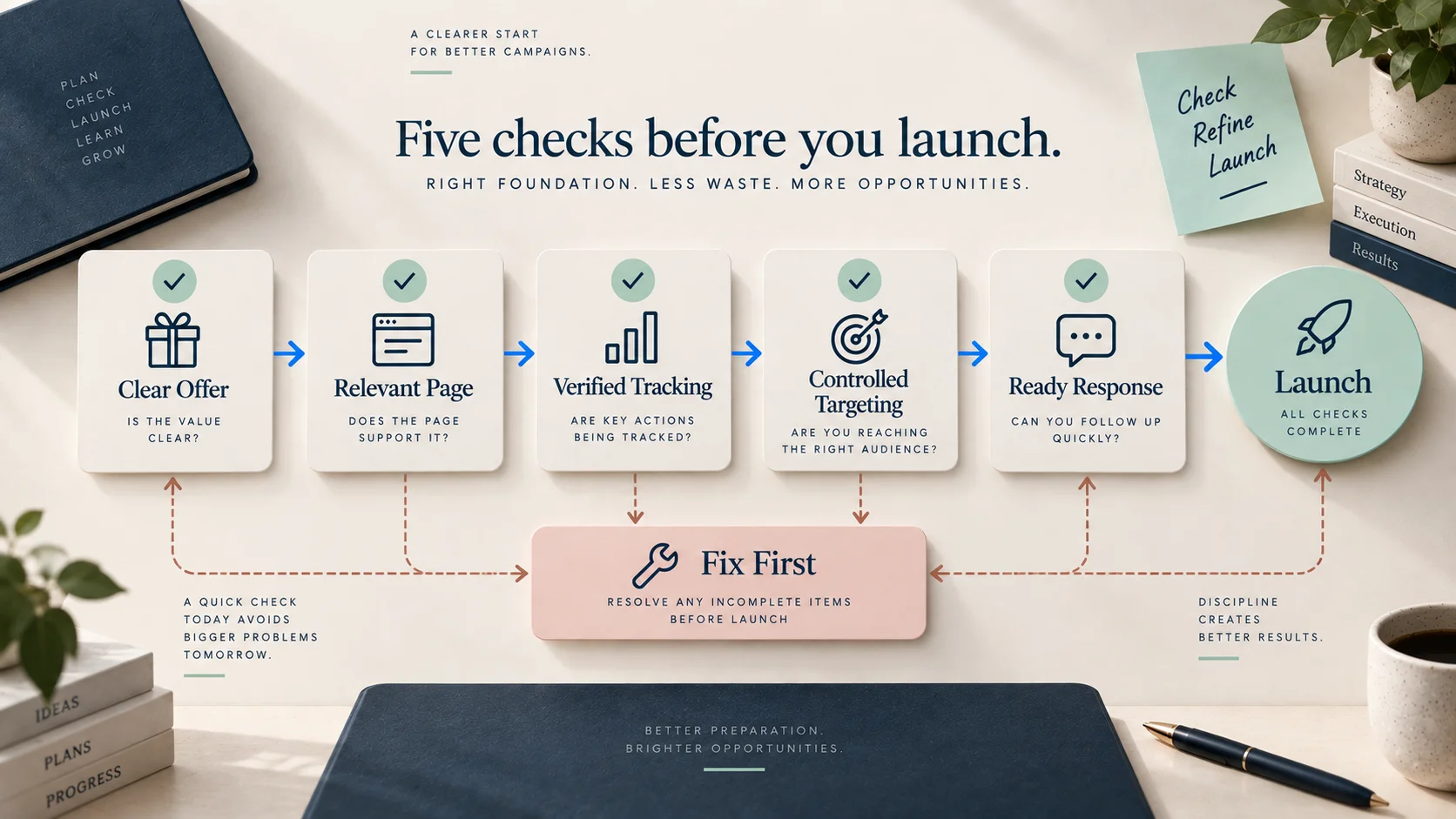
If any of the landing page, primary conversion, tracking or lead ownership rows are not ready, pause the launch.
Three practical examples
These scenarios illustrate decisions; they are not case studies or result promises.
Example 1: A web-development company targeting every service
The company wants to advertise websites, apps, branding, SEO, social media and AI automation in one campaign. It sends all traffic to the homepage. The form asks only for name and phone number, and every submission is counted equally.
What to fix first: choose one commercially important service and audience. Build a page that explains that offer, create a relevant search theme, define a qualified enquiry and add lead-status feedback. Other services can receive separate campaigns later if the first system works.
Why: the original scope makes it difficult to connect a search, message, page and outcome.
Example 2: A college promoting admissions
The college wants immediate applications. The programme page lists a course name but not eligibility, duration, fees process, outcomes, location or application steps. The campaign proposes counting brochure downloads as applications.
What to fix first: strengthen the programme and admissions journey, define application and verified-enquiry conversions separately, confirm deadlines and geography, test mobile forms and assign an admissions response owner.
Why: advertising can create interest, but the page must answer the questions that determine whether a student can proceed.
Example 3: A local high-intent service
An emergency repair business has clear service areas and phone coverage. The website loads quickly and calls can be tracked, but the campaign location setting includes people merely interested in the city, the schedule runs overnight without staff and broad queries produce DIY searches.
What to fix first: review the available presence-based location options, align schedule with response capacity, inspect search terms, add justified exclusions and confirm call-quality feedback.
Why: the offer is ready, but targeting and operations are allowing avoidable waste.
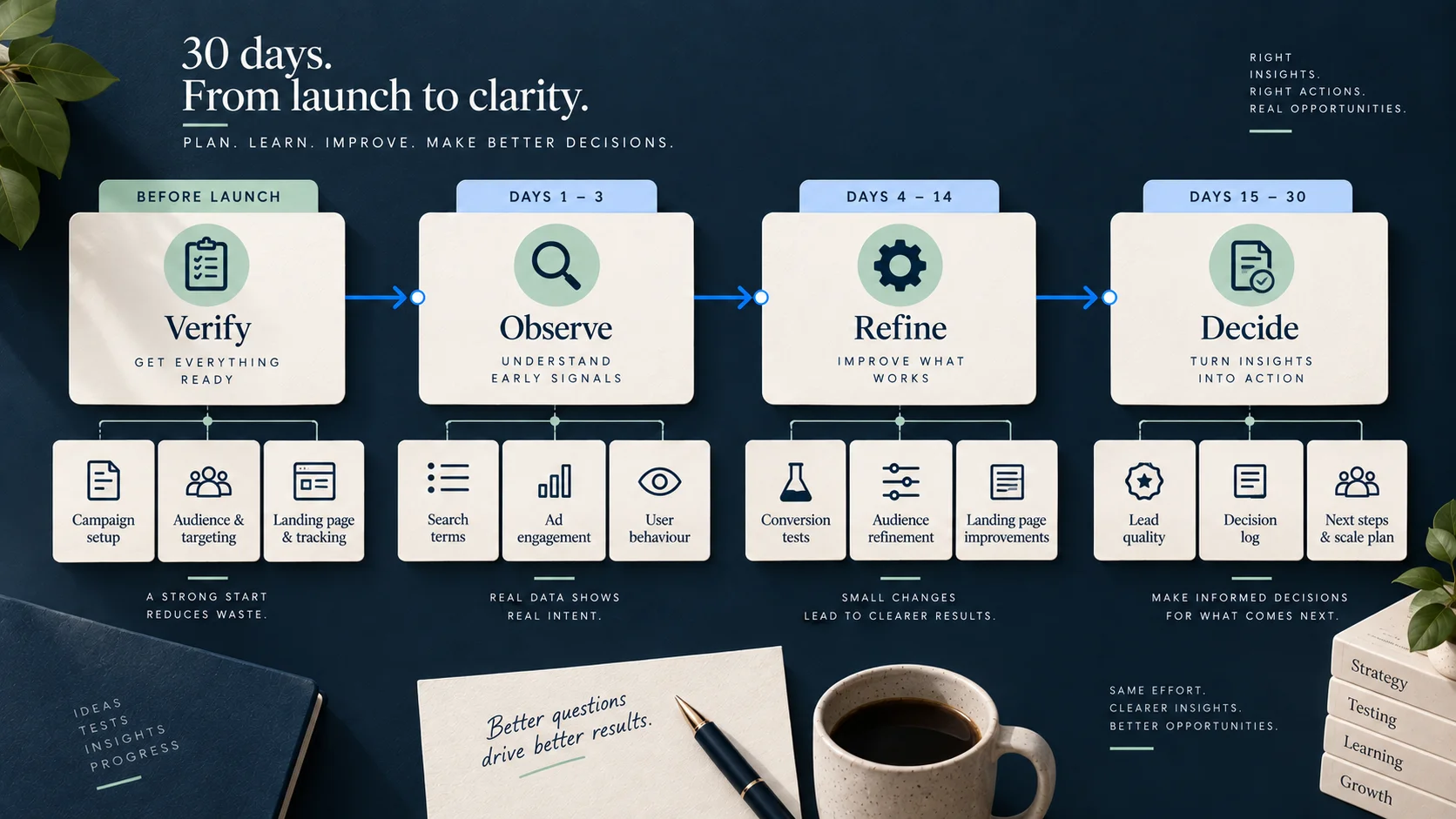
A sensible first-30-days operating plan
The first month should be a controlled learning period, not a promise of permanent performance.
Before day 1
- approve the campaign brief;
- test the landing page and forms;
- verify primary and secondary conversions;
- document initial keywords, match types and exclusions;
- confirm locations, languages, schedules and devices;
- review advertisements and destinations;
- confirm budget, billing and account access;
- brief the enquiry-handling team;
- record baseline website and lead data.
Days 1–3
- verify advertisements are eligible and landing pages remain available;
- check spend and geographic delivery;
- confirm conversions record correctly;
- inspect early search terms for obvious mismatches;
- confirm real leads arrive in the correct system;
- fix broken measurement before interpreting performance.
Days 4–14
- review search terms and negative-keyword opportunities;
- assess message-to-page consistency;
- compare conversions with actual lead records;
- identify device, location and schedule problems;
- record changes in the decision log;
- avoid changing several major variables at once without a clear reason.
Days 15–30
- classify leads by validity and quality;
- compare campaign themes and landing-page outcomes;
- identify questions or objections missing from the page;
- review spend against the approved learning plan;
- decide whether evidence supports maintaining, refining, expanding or stopping;
- document what should feed future SEO and website improvements.
Do not scale because the dashboard shows a high number of conversions if those conversions are weak actions or poor-fit enquiries.
Common ways businesses waste Google Ads budget
Launching before conversion tracking is verified
The campaign starts collecting clicks while nobody can confidently identify valuable actions. Later, historical truth cannot be reconstructed completely.
Sending every search to one generic page
The visitor expects a specific solution and receives a broad company introduction. Relevance and trust fall after the paid click.
Treating exact match as exact wording
Modern keyword matching considers meaning and intent. Review actual search terms rather than assuming syntax provides perfect control.
Copying negative keywords from another account
The list blocks searches that may be valuable for this business or fails to address its real irrelevant traffic.
Counting easy actions as primary success
Button taps, page views and form starts may inflate conversions while producing no real conversations.
Using a daily budget without understanding total exposure
The approver assumes the platform will spend the identical amount every day and has not reviewed billing-period behaviour or account settings.
Optimising for lead volume without sales feedback
The campaign finds more people likely to submit a form, but the team never tells the system or manager which leads are valid.
Expanding geography too soon
The campaign covers areas the business cannot serve efficiently because the potential audience looked larger.
Changing everything after a few days
Keywords, advertisements, page, goal and bidding change together. The team can no longer tell which change helped or harmed.
Ignoring calls and messages after office hours
The campaign generates attention when the business is unable to respond, creating wasted opportunity and poor customer experience.
Letting an external manager own the account
When the relationship ends, the business loses history, access or control over critical assets.
Questions to ask an agency or campaign manager
- What business outcome will the campaign optimise toward?
- Which actions are Primary conversions and which are Secondary?
- How was conversion tracking tested?
- Which campaign type are you recommending, and why?
- Which audience or search intentions are included and excluded?
- Where will each advertisement send the visitor?
- How will search terms and negative keywords be reviewed?
- Which location option is being used, and why?
- What is included in the budget beyond media spend?
- How will lead quality be collected from our team?
- What will make you pause or stop the campaign?
- How often will operational checks and strategic reviews happen?
- Who owns the Google Ads account and linked assets?
- Can we see change history, billing and conversion definitions?
- How will the learning improve our website and future marketing?
A capable manager should explain these decisions without hiding behind platform terminology.
Frequently asked questions
How much should a small business spend on Google Ads?
There is no universal starting amount. The budget should reflect expected click costs, the number of interactions needed for meaningful learning, customer economics, campaign scope and the amount the business can responsibly test. Include setup, landing-page, tracking and management costs—not only media spend.
Should I run Google Ads without a landing page?
You need a relevant destination, but it does not always have to be a newly designed standalone landing page. A strong service, product, programme or category page may be suitable if it closely matches the advertisement and supports the intended action. A vague homepage is rarely the best default for a focused campaign.
Can I start Google Ads before my website is complete?
Only if the specific campaign journey is complete and trustworthy. The destination must explain the offer, provide necessary proof, work on mobile, collect the intended action, confirm it and support accurate measurement. If the broader site still damages trust or creates broken paths, finish those essentials first.
Is a WhatsApp click a conversion?
It can be tracked as an interaction, but a click does not prove that a message was sent, read or qualified. Treat it as a secondary signal unless you have a reliable way to confirm the meaningful outcome.
Do exact-match keywords show only for the exact words?
No. Google’s current documentation says exact match may show for searches with the same meaning or intent. Review search terms and lead quality rather than relying only on the keyword notation.
Should I use broad match?
Broad match can reach related searches and Google recommends using it with Smart Bidding. Whether it is appropriate depends on conversion quality, budget, account maturity, campaign objective and management capability. It should not be activated casually in an account with weak tracking and no search-term review.
How soon should I judge the campaign?
Fix broken tracking, irrelevant destinations and obvious targeting errors immediately. Judge commercial performance only after enough relevant data and lead feedback exist for the business model. A fixed universal number of days or clicks would be misleading.
What matters more: click-through rate or conversions?
Click-through rate helps diagnose whether an advertisement attracts attention, but the business needs meaningful conversions and qualified outcomes. A high click-through rate can still waste money if the message attracts the wrong people.
Can Google Ads fix a website that does not generate enquiries?
No. It can send more people to the website, which may make the weakness more visible. Fix message, relevance, trust, mobile use, form friction and follow-up before increasing traffic.
Should the agency own my Google Ads account?
The business should retain ownership and grant appropriate access to managers. This protects history, billing visibility and continuity if partners change.
Spend only when the next step is ready
Google Ads can be a powerful way to meet existing demand, test a focused offer and create timely visibility. The platform becomes expensive when the business asks it to solve problems that exist before or after the click.
Do not begin with the budget field. Begin with the journey:
- define the business outcome;
- clarify the offer;
- understand the search intention;
- select an explainable campaign structure;
- prepare the page;
- identify a real conversion;
- test measurement;
- configure targeting consciously;
- prepare the response team;
- connect platform activity to customer quality.
When those pieces are ready, the campaign has a fair opportunity to learn. When they are missing, waiting is not hesitation. It is discipline.
Planning a Google Ads campaign but unsure whether the page, tracking and lead process are ready? Review your campaign foundation with Nothing Down. We will help you identify what should be fixed before the budget goes live.