A customer asks a good question during a call. You answer it clearly, the conversation moves forward and the answer disappears when the meeting ends.
The same question appears in a direct message two weeks later. Someone on the team answers it again. It appears in an email the following month. Again, the business explains it privately to one person.
This is one of the most common missed opportunities in business content. The useful idea already exists. It has been tested in a real conversation. It is expressed in the language customers actually use. Yet it never becomes part of the public content system.
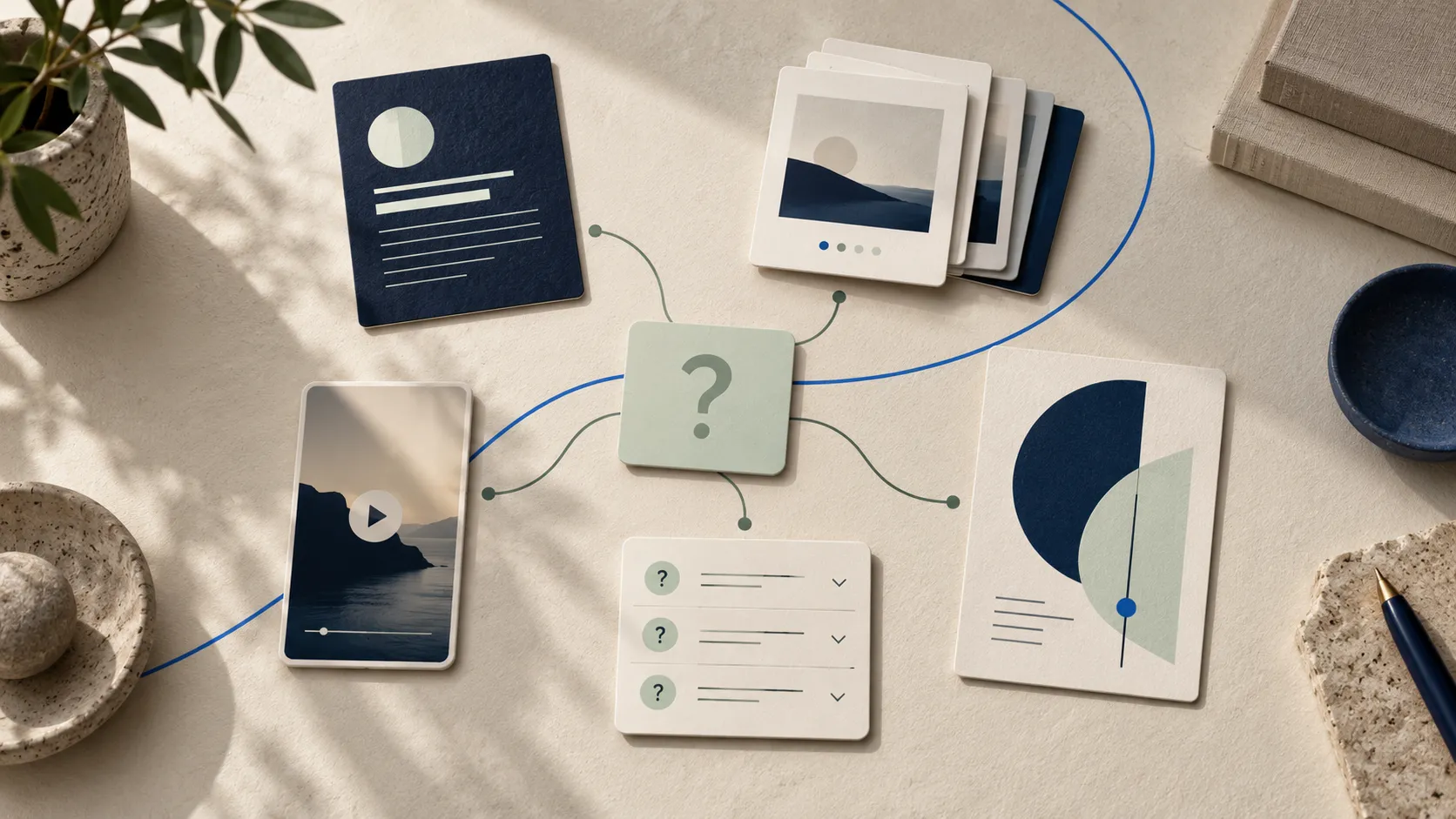
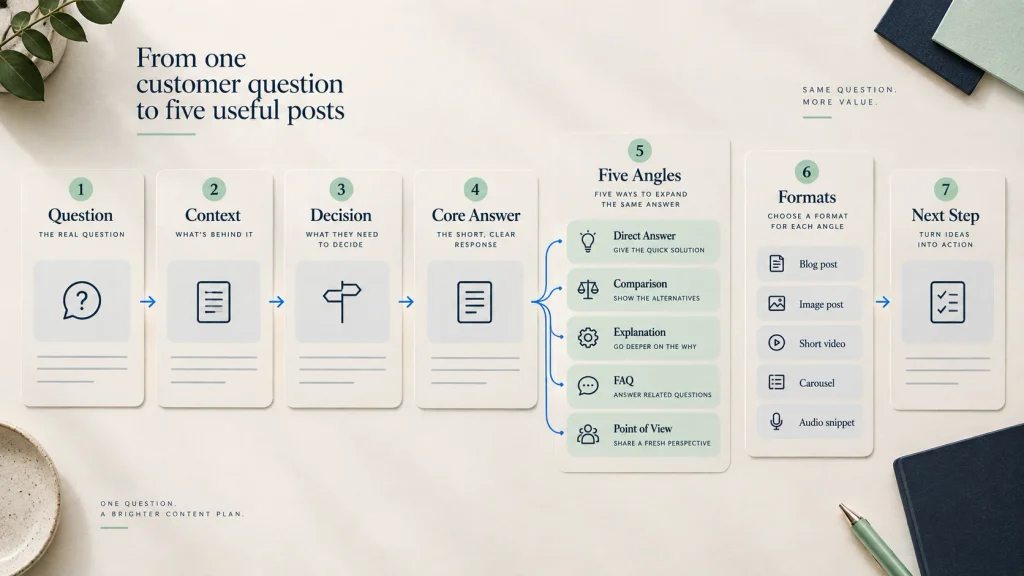
One genuine customer question can create several useful posts without forcing the team to repeat the same caption five times. The key is to preserve the central answer while changing the purpose, depth, angle and experience of each format.
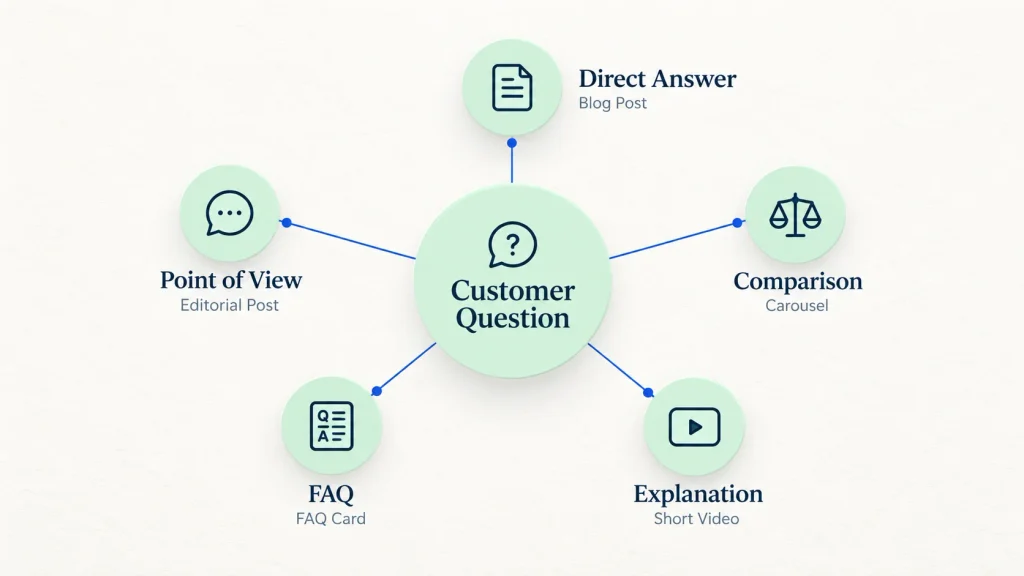
This guide shows you how to do that. It includes a complete worked example—a text post, carousel, short video, FAQ post and point-of-view post—plus a repeatable workflow for turning almost any meaningful customer question into a small, connected content series.
The short answer
To turn one customer question into five useful posts:
- Record the question in the customer’s actual language.
- Identify what the person is really trying to decide.
- Write one accurate core answer before choosing formats.
- Break the answer into distinct content angles.
- Match each angle to the format that explains it best.
- Give every post a different job in the customer journey.
- Publish the series with enough space and context to avoid repetition.
- Link interested readers to a useful next step.
- Review the questions and actions the posts generate.
The five posts should feel related, but each one should reward the audience with something new. Repurposing is not copying. It is redesigning one useful idea for different moments of attention.
Why customer questions are strong content material
Most businesses do not suffer from a complete absence of ideas. They suffer from a gap between the people who hear customer questions and the people responsible for content.
Customer questions are valuable because they contain several signals at once:
- The subject matters enough for someone to ask.
- The language comes from the audience, not the marketing department.
- The question often reveals uncertainty that prevents action.
- The answer allows the business to demonstrate useful knowledge.
- Similar people may be carrying the same doubt silently.
- The question can connect naturally to a service, product or resource.
A question such as “How much does it cost?” may initially feel too broad. Beneath it, the person may be asking what affects the cost, whether the investment is predictable, how options differ or whether the service fits their stage. Each underlying concern can become a useful content angle.
The previous article, What Should Your Business Post on Social Media?, explains how customer questions fit alongside work, expertise, perspective, process and offers. This article goes deeper into the production method for that one pillar.
Do not begin with “How can we make five posts?”
If the team begins by demanding five assets, the idea can become thin. A simple answer is stretched into an eight-slide carousel. The same sentences become a video script. A quote is extracted even though nobody would naturally say it. Quantity becomes the goal.
Begin with the customer’s decision instead.
Ask:
- What is the person trying to understand?
- What decision will this answer help them make?
- What assumption may be creating confusion?
- Which part can be answered simply?
- Which part needs context or qualification?
- What evidence would make the answer more credible?
- What useful next step follows from the answer?
If the question supports only one clear post, create one strong post. The five-post method is appropriate when the subject has enough depth to support different reader needs without adding filler.
Step 1: Capture the question accurately
Write the question as the customer asked it. Do not immediately translate it into industry language or a search keyword.
A customer may ask:
Do we really need a full website, or can we just start with one landing page?
That wording contains more insight than “website vs landing page content.” The words “really need” suggest concern about unnecessary cost or complexity. “Just start” suggests the customer may be in an early stage or trying to launch quickly.
Record the context with the question:
- Who asked it?
- What were they planning?
- What did they already understand?
- Which option did they assume was simpler?
- What did they ask immediately afterward?
- What answer helped the conversation move forward?
Do not store personal or confidential information in the content bank. Capture the learning, not the customer’s identity.
Where useful questions appear
- Enquiry forms
- Discovery calls
- Sales meetings
- Customer support
- Comments and direct messages
- Product reviews
- Internal sales notes
- Search terms and site-search data
- Proposal discussions
- Project kickoffs
- Questions asked after delivery
A simple shared form can ask the team to submit the question, context, short answer and whether an example is available. This takes minutes and creates a source of ideas grounded in real work.
Step 2: Find the question beneath the question
The spoken question is not always the complete concern.
“Do we need a website or landing page?” may contain several hidden questions:
- Are we about to spend more than necessary?
- Can we launch quickly without looking temporary?
- Will one page be enough to explain the business?
- Which option will generate enquiries?
- Can we begin small and expand later?
- Does advertising require a different page?
You do not need to answer every possible concern in one post. Identifying them gives the content series range. One post can provide the quick distinction. Another can show the decision criteria. Another can correct the assumption that a landing page is simply a cheaper website.
This is where useful repurposing begins: not by changing the dimensions of an asset, but by serving different parts of the same decision.
Step 3: Write the core answer before the content
Create one internal answer that is accurate, balanced and specific. It may never be published exactly as written. It is the source of truth for every format.
For the example question, the core answer could be:
Choose a website when people need to understand the wider business, explore several services or build confidence through work, team and company information. Choose a landing page when one defined audience is arriving for one defined offer and should take one primary action. Many established businesses need both: a website as the long-term home and landing pages for focused campaigns. The decision should be based on purpose, not simply page count or price.
This answer creates boundaries. It prevents one post from saying “Every business needs a website” while another suggests that landing pages always convert better. The formats can differ, but the underlying advice remains consistent.
For a detailed explanation of this example, link readers to Website or Landing Page: Which Does Your Business Need? rather than trying to fit the complete decision into every social post.
Check the core answer
Before creating content, confirm:
- Is it factually accurate?
- Does it answer the real decision?
- Are important conditions included?
- Does it avoid guarantees the business cannot make?
- Can it be understood without specialist language?
- Is there a real example or analogy that supports it?
- Does the business follow this advice in its own work?
If a subject involves health, finance, law, safety or another high-impact area, involve an appropriate qualified reviewer and use reliable sources. A frequently asked question is not automatically safe to answer casually.
Step 4: Give the five posts different jobs
One idea becomes repetitive when every version does the same job.
Assign a distinct purpose to each post:
| Post | Primary job | Reader outcome |
|---|---|---|
| Direct-answer text post | Clarify | Understand the basic distinction quickly |
| Carousel | Compare | Evaluate the choice using several criteria |
| Short video | Humanise and explain | Hear the reasoning in a natural voice |
| FAQ post | Remove one objection | Resolve a specific practical doubt |
| Point-of-view post | Position | Understand the principle behind the business’s approach |
These posts belong to the same theme, but they are not duplicates. Together they help the audience recognise the question, understand the options, trust the source and move toward a useful next step.
The worked example
The example question is:
Do we need a full website, or can we start with a landing page?
The following five pieces are written as ready-to-adapt examples for a creative or digital service business. Replace the examples and CTA with facts that fit your offer.
Post 1: The direct-answer text post
Purpose
Give the audience a useful answer quickly. This works when the question can be clarified in a short written format without a large visual explanation.
Draft copy
A landing page is not simply a smaller website.
A website helps people understand the wider business: its services, work, team, process and ways to make contact.
A landing page focuses one audience on one offer and one main action.
Choose a website when visitors need to explore and build confidence over time.
Choose a landing page when people arrive from a specific campaign and should consider one clear next step.
Many businesses eventually need both.
The better question is not “How many pages can we afford?”
It is: “What does this visitor need to understand and do?”
If the answer involves several audiences and several journeys, plan a website.
If it involves one defined audience, one promise and one action, plan a landing page.
Which are you planning right now: a long-term business presence or one focused campaign?
Why it works
The first line corrects a common assumption without exaggeration. The post gives the distinction before asking for engagement. The closing question is easy to answer and helps the business learn about the audience’s current situation.
Visual direction
Use a simple split graphic: a connected group of page cards on one side and one focused page leading to one action on the other. The visual should reinforce the distinction rather than repeat the entire caption in small text.
Post 2: The comparison carousel
Purpose
Help a person evaluate the choice across several criteria. A carousel is appropriate because the reasoning benefits from sequence.
Seven-slide carousel copy
Slide 1 — Cover
Website or landing page?
Choose by purpose—not page count.
Slide 2 — Start here
What must the visitor do?
Explore the wider business?
Or consider one focused offer?
Slide 3 — Choose a website when…
- You offer several services
- Visitors need proof and company information
- Different audiences need different paths
- The platform must grow over time
Slide 4 — Choose a landing page when…
- One campaign has one audience
- The offer is specific
- The traffic source is known
- One primary action matters
Slide 5 — A common mistake
Sending a focused advertisement to a general homepage.
The visitor must search for the promise they already clicked.
Slide 6 — Many businesses need both
Website = the long-term home.
Landing page = the focused campaign path.
Slide 7 — The decision question
Does this experience support one clear action—or several meaningful journeys?
Use the answer to choose the format.
Caption
The difference is not simply “many pages versus one page.”
A website and a landing page organise attention differently.
Before choosing, define the audience, traffic source, information required for trust and the next action. That will tell you more than an arbitrary page count.
For a complete comparison, read our practical guide: Website or Landing Page: Which Does Your Business Need?
Why it works
Each slide advances the decision. The carousel does not hide the answer until the end, and it does not stretch one sentence across multiple slides. The caption adds context instead of repeating every slide.
Design notes
- Make the cover readable at thumbnail size.
- Keep one idea per slide.
- Use large type and short lines.
- Maintain consistent placement for headings and slide numbers.
- Include a clear final action without turning every slide into a sales message.
- Add alternative text or an accessible caption containing the meaningful information.
Post 3: The 45-second short video
Purpose
Use voice and pacing to make the reasoning feel direct and human. The video should not be a spoken version of the carousel.
Hook
If you are choosing between a website and a landing page, do not begin with the number of pages.
Spoken script
Begin with the decision your visitor needs to make.
If people need to understand your wider business—your services, work, team and process—you probably need a website.
If one specific audience is arriving from one campaign for one offer, a focused landing page may be enough.
And if you already have a business website but you are launching a particular campaign, you may need both.
The website creates the wider confidence. The landing page keeps the campaign focused.
So before asking, “How many pages do we need?” ask, “What does this visitor need to understand and do next?”
Beat sheet
| Time | Spoken idea | Visual direction | On-screen text |
|---|---|---|---|
| 0–4 sec | Do not begin with page count | Presenter to camera; quick cut to two page sketches | Do not start with page count |
| 4–14 sec | When a website fits | Show connected page cards or sitemap | Several services. Several journeys. |
| 14–24 sec | When a landing page fits | Show one page connected to one campaign | One audience. One offer. One action. |
| 24–34 sec | Why both can work | Place the website and campaign page side by side | A long-term home + focused campaigns |
| 34–45 sec | The decision question | Return to presenter; clean final frame | What must the visitor understand and do? |
Caption
Choose the format around the visitor’s decision.
A website explains the wider business. A landing page focuses one campaign. The right answer may be one—or both.
Why it works
The script uses spoken rhythm, a simple visual comparison and one memorable decision question. It gives the answer inside the video, so the caption can remain concise.
Post 4: The FAQ post
Purpose
Resolve one practical objection for people who understand the basic difference but are still uncertain about starting small.
Question
Can we begin with a landing page and build the full website later?
Answer
Yes—when the first stage has a clear purpose.
A landing page can be a sensible starting point for one offer, a launch, an event or early demand validation. It should still include accurate business information, a credible message, privacy details and a working follow-up process.
Plan the technical foundation so it can grow, keep ownership of the domain and accounts, and record what you learn from enquiries.
Do not keep adding unrelated services and company information until the landing page becomes a difficult one-page website. When visitors need several meaningful paths, it is time to build the wider structure.
Suggested single-graphic copy
Can we start with a landing page?
Yes—if one audience, one offer and one action are enough for the first stage.
CTA
Save this question for your project-planning conversation, or read What to Prepare Before Starting a Business Website when you are ready to organise the wider build.
Why it works
The FAQ chooses one objection instead of repeating the entire comparison. It answers “yes” with the conditions required to make the advice responsible.
Post 5: The point-of-view post
Purpose
Reveal the principle behind the business’s approach. This helps the audience understand not only what you recommend, but how you make decisions.
Draft copy
A business does not need more pages than the customer journey requires.
It also should not force a complex business into one page simply because one page appears faster or cheaper.
We see page count treated as the starting point for website proposals:
“How much for five pages?”
But a page has no value merely because it exists.
A useful website might need a clear service structure, several forms of proof and different paths for customers, partners and candidates.
A useful landing page might need one focused argument, one relevant example and one next step.
The right scope comes from the information and decisions the visitor needs—not from filling a menu or reducing the work to an arbitrary number.
Start with the journey. Let the page count follow.
CTA
If you are preparing a website brief, write down the audiences, questions and actions before deciding how many pages to request.
Why it works
This post takes a position the business can demonstrate through its process. It avoids attacking other providers or presenting a personal preference as a universal rule. It also creates a natural link to a preparation guide without making the entire post promotional.
What changed across the five posts?
The central answer stayed consistent. The communication job changed.
| Format | What it emphasised | What it deliberately left out |
|---|---|---|
| Text post | The simplest distinction | Detailed comparison criteria |
| Carousel | Step-by-step evaluation | Longer explanation and nuance |
| Short video | Human reasoning and memorable question | Full project-planning detail |
| FAQ post | Starting small and expanding later | Other reasons to choose each format |
| Point-of-view post | Principle behind scoping | Complete how-to guidance |
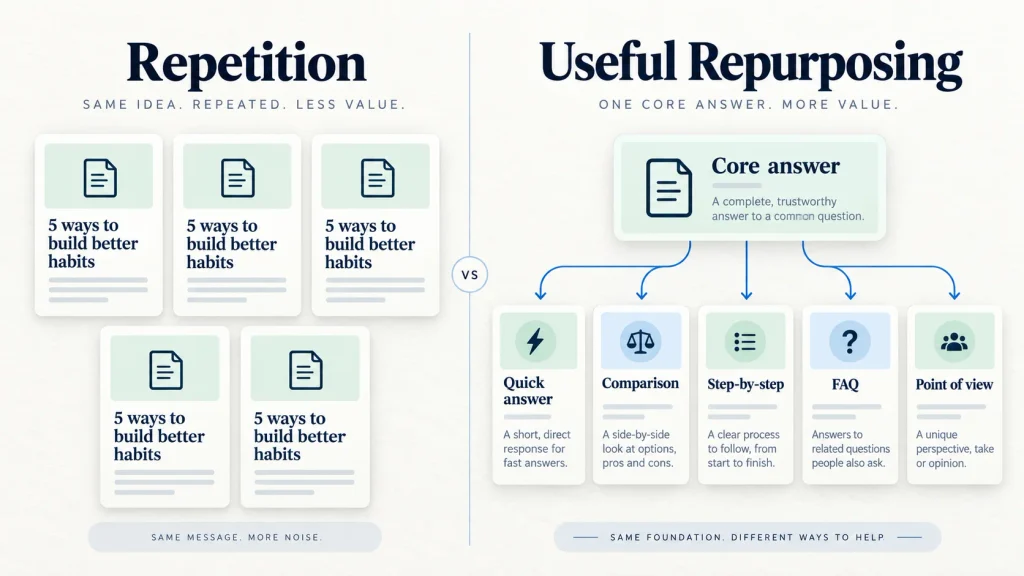
This is the standard for useful repurposing: the audience should gain a new understanding from each version, even when they have seen another post in the series.
Step 5: Find five angles before choosing five formats
The worked example used clarification, comparison, explanation, objection handling and point of view. Other questions may require different angles.
Use this angle bank:
Direct answer
What is the shortest accurate response?
Decision criteria
Which factors change the answer?
Common assumption
What do people often misunderstand about the subject?
Process
How does the business handle this question in practice?
Example
What realistic scenario makes the answer easier to see?
Comparison
Which two options is the customer choosing between?
Mistake
What happens when the decision is made for the wrong reason?
Preparation
What information should the customer bring before moving forward?
Objection
What concern remains after the basic answer?
Point of view
Which principle shapes the business’s recommendation?
Offer connection
When does the business’s service become relevant?
Choose angles with enough separation. “Three benefits,” “five benefits” and “our favourite benefits” are not meaningfully different posts.
Step 6: Match the angle to the format
Do not decide that every question must produce a Reel, carousel, poll, graphic and article. Select formats based on what the idea needs.
| Angle | Often suits | Reason |
|---|---|---|
| Direct answer | Text post, talking-head video, single graphic | The value is immediate clarity |
| Multi-factor comparison | Carousel, table, longer article | The audience needs to evaluate several dimensions |
| Demonstration | Video, annotated images, screen recording | The process is easier to see than describe |
| Objection | FAQ post, story sequence, short video | One focused doubt can be resolved directly |
| Process | Carousel, behind-the-scenes video, diagram | Sequence and responsibility matter |
| Point of view | Founder video, text post, editorial graphic | Voice and reasoning carry the idea |
| Detailed preparation | Checklist, article, downloadable guide | The information needs reference value |
The format should reduce the effort required to understand the idea. If it adds decoration but removes clarity, choose another format.
Step 7: Change the opening, not the truth
Each post needs an opening suited to its job. That does not mean inventing five dramatic claims.
For the same website-versus-landing-page question:
- Direct answer: “A landing page is not simply a smaller website.”
- Comparison: “Choose by purpose—not page count.”
- Video: “Do not begin with the number of pages.”
- FAQ: “Can we start with a landing page and build later?”
- Point of view: “Start with the journey. Let the page count follow.”
These openings create different reasons to continue while remaining faithful to the same subject.
Avoid hooks that promise a level of certainty the content cannot support:
- “Landing pages always convert better.”
- “Every business needs these five website pages.”
- “This one page made us millions.”
- “Your website is failing because of this secret.”
A strong hook creates relevant tension. It does not need to deceive the reader.
Step 8: Use a connected but non-repetitive publishing sequence
Publishing five related posts on five consecutive days may feel repetitive unless the subject is part of a focused campaign or educational series. Give the idea room.
A practical sequence could be:
- Week 1: Direct-answer post
- Week 2: Comparison carousel
- Week 3: Short video answering the decision question
- Week 4: FAQ post about starting small
- Week 5 or 6: Point-of-view post connected to your project process
Between them, publish work, people, offers or other customer questions. The audience receives thematic consistency without seeing the same subject every time they open the feed.
You can also adapt the sequence across platforms. A short video may appear on Instagram and YouTube, while the point-of-view post appears on LinkedIn and the detailed answer lives on the website. Adapt the opening, pacing, caption and CTA rather than copying every element unchanged.
Step 9: Give the series a useful destination
Social posts can answer the immediate question, but some readers will need more detail. Create or select a destination that continues the promise.
That destination may be:
- a detailed insight article;
- a relevant service page;
- a project or case study;
- a comparison or checklist;
- a product page;
- an event page;
- a contact page for a defined conversation.
Do not send every post to the homepage by default. If the post discusses one specific question, link to the resource that answers it fully. A focused post followed by an unrelated page breaks the journey.
If people click but do not progress, inspect the page message, trust, mobile experience, form and response process. Why Your Website Gets Visitors but Few Enquiries provides a practical diagnostic framework.
A repeatable customer-question worksheet
Use this worksheet before producing the content.
Source question
Write the customer’s exact words:
________________________________________________________
Context
Who asked, what were they planning and what did they already know?
________________________________________________________
Decision beneath the question
What are they actually trying to choose, avoid or understand?
________________________________________________________
Core answer
Write one accurate internal answer in three to six sentences:
________________________________________________________
Conditions and limitations
When does the answer change? What should not be promised?
________________________________________________________
Evidence
Which real example, process, demonstration or source supports the answer?
________________________________________________________
Five angles
- Direct answer:
________________________________________ - Comparison or criteria:
_______________________________ - Example or process:
___________________________________ - Objection or FAQ:
_____________________________________ - Point of view or offer connection:
____________________
Five formats
Choose a format only after choosing the angle:
______________________________________________________________________________________________________________________________________________________________________________________________________________________________________________________________________________
Next step
Where should an interested reader go?
________________________________________________________
Examples from other kinds of businesses
The following examples are illustrative. They show how the method changes by industry without inventing customer results.
Fashion brand
Customer question: Will this necklace work with both traditional and modern outfits?
Five angles could include a direct styling answer, a three-look carousel, a short try-on video, an FAQ about scale and weight, and a founder post explaining why versatile pieces are selected. The product facts must remain consistent, while the visual context changes.
Manufacturer
Customer question: What information do you need before providing a quotation?
Five angles could include a quotation checklist, a carousel explaining why specifications matter, a video from the technical team, an FAQ about minimum quantities and a process post showing what happens after an enquiry. Sensitive customer drawings or specifications should never be exposed.
University or college
Customer question: How do I choose between two related programmes?
Five angles could include a quick distinction, curriculum comparison carousel, faculty explanation video, admissions FAQ and a student-project post showing the kind of work each programme includes. Eligibility, approvals, fees and outcome claims must be verified before publication.
Local service business
Customer question: How soon should we call after noticing this problem?
Five angles could include an immediate warning-sign post, a visual severity guide, a technician video, a safety FAQ and a post explaining what happens during the first visit. High-impact safety advice should be reviewed by someone appropriately qualified.
Professional consultancy
Customer question: Do we need a full project or can you review what already exists?
Five angles could include a direct answer, diagnostic criteria, review-process video, FAQ on scope and a point-of-view post about improving before rebuilding. This can connect naturally to the consultancy’s initial assessment offer.
Build the capture system around real work
The method becomes sustainable when questions are captured continuously instead of collected during an emergency content meeting.
Create one shared question bank with these fields:
| Field | Purpose |
|---|---|
| Exact question | Preserves customer language |
| Source | Shows whether it came from sales, support, search or another channel |
| Audience | Identifies who needs the answer |
| Context | Prevents the question from becoming misleadingly broad |
| Short answer | Gives the content team a factual starting point |
| Subject expert | Identifies who can verify the answer |
| Evidence available | Lists examples, visuals, data or demonstrations |
| Sensitivity | Flags confidentiality, permissions or regulatory review |
| Possible destination | Connects the post to an article, service or product page |
| Status | Captured, selected, drafted, reviewed, published or updated |
Ask sales and support teams for questions regularly. Review enquiry forms and website search data. Listen for the moment someone says, “People always ask us…” That sentence often contains the next useful content series.
Keep the five posts consistent with the brand
Repurposed posts should feel connected even when their layouts differ. Use a stable system for typography, colour, image treatment, diagrams, tone and terminology.
Consistency does not require placing every idea inside the same template. The carousel may use structured cards, the video may feel more human and the FAQ may be a quiet single graphic. The relationship comes from the brand’s point of view and the clarity of the system.
If the team is using only a logo and guessing the rest each week, Logo vs. Brand Identity: What Does Your Business Actually Need? explains why a wider identity system matters. When a partner is designing that system, What to Include in a Brand Design Brief helps organise the business context without dictating the creative solution.
Most importantly, the message must remain stable. A different format can change the pace and emphasis; it should not change who the offer is for or what the business believes. Before You Redesign Your Logo, Clarify Your Message provides the foundation for that consistency.
Use AI to shape the material—not invent the experience
AI can help transform a verified core answer into draft angles, hooks, carousel structures and scripts. It can also compare versions, remove repetition and adapt the language to different formats.
The quality depends on the source material. Provide:
- the exact customer question;
- the context in which it arose;
- the approved core answer;
- real examples or proof;
- the brand voice;
- claims that must not be made;
- the intended audience and CTA.
Then involve a knowledgeable person in review. AI should not invent a customer story, performance result, product property, legal interpretation or first-hand lesson. The business remains responsible for what it publishes.
A practical drafting prompt
Turn the approved customer question and core answer below into five distinct content angles. Each angle must serve a different reader need. Recommend a suitable format for each. Preserve all factual conditions, do not invent results or examples, avoid sensational hooks, and identify any statement that requires verification. Keep the tone clear, professional and human.
Use the output as a starting point, not an automatic publishing system.
Measure the series as a connected idea
Do not judge every format by the same metric.
- The direct-answer post may generate comments from people facing the decision.
- The carousel may earn saves because it functions as a reference.
- The short video may reach more new people.
- The FAQ may generate qualified profile or page visits.
- The point-of-view post may be referenced during a sales conversation.
Review:
- relevance of the people reached;
- completion or reading behaviour where available;
- saves, shares and meaningful questions;
- visits to the intended article or service page;
- assisted enquiries and sales feedback;
- new customer questions generated by the series;
- whether the core answer remains accurate over time.
Avoid claiming that one post caused a sale unless the evidence supports that connection. Social content often influences a longer path involving search, direct visits, recommendations and repeated exposure.
The most valuable result may be a sharper next question. That question can improve the article, sales process and next content series.
Common repurposing mistakes
Copying the same caption into five formats
Changing the dimensions does not change the value. Give each post a distinct purpose and angle.
Stretching a small answer too far
Not every question contains five posts. Protect usefulness before volume.
Removing the answer to create engagement
“Comment YES and we will send the answer” adds friction when the answer could be given directly. Use gated resources only when the additional resource genuinely deserves the exchange.
Choosing formats before understanding the question
The team decides it needs three Reels and two carousels, then searches for ideas to fill them. Reverse the order: question, answer, angle, format.
Repeating the same hook
If every post begins “Website or landing page?” the series feels mechanical. Change the opening according to the reader need while preserving the truth.
Publishing the entire series too closely
Unless it is a deliberate short campaign, allow space between related posts and mix them with other content pillars.
Losing important conditions
Short formats can make qualified advice sound absolute. Keep the condition that changes the answer, and direct people to deeper material where necessary.
Using a question only as a hidden sales pitch
Answer the question well. Connect the offer where it is relevant, but do not make every educational post a long route to “Contact us.”
Forgetting permissions and confidentiality
Remove identifying details, obtain permission for customer material and review sensitive information before publication.
Creating content without a destination
If the audience wants more detail, provide a useful article, service page, project or next step. Plan the destination as part of the series.
Frequently asked questions
Can every customer question become five posts?
No. Some questions need one direct answer. Use five formats only when the subject contains distinct angles that remain useful. Do not dilute a simple idea to meet a production target.
Will the audience notice that we are repeating ourselves?
They may notice a consistent theme, which is useful. Repetition becomes a problem when the insight, wording and format remain the same. Change the reader outcome—not only the design.
How far apart should related posts be published?
There is no universal interval. For an educational series, several posts may appear close together. For an evergreen theme, spread them across several weeks and combine them with other pillars. Use the audience response and campaign goal to decide.
Which customer question should we start with?
Choose a question that appears repeatedly, affects an important decision, connects to real expertise and can be answered responsibly. A specific question is usually more useful than a broad topic.
Should every post link to the same article?
Not necessarily. The comparison carousel may link to the detailed guide. The FAQ may link to a preparation checklist. The point-of-view post may not need a link at all. Give each post the next step that fits its role.
Can we use the customer’s exact words?
You can use the general wording of a question when it does not identify the person or expose confidential information. Remove private details and avoid presenting a composite question as a direct quotation from a named customer.
What if different team members give different answers?
Resolve the disagreement before publishing. The question may reveal an unclear offer, inconsistent sales process or missing policy. Content can help align the organisation, but it should not publish conflicting promises.
Should we create the long article first or the social posts first?
Either can work. A detailed article can become the source for shorter content, while a strong customer question can be tested through social posts before becoming an article. In both cases, write and approve the core answer first.
How do we prevent the content from sounding generic?
Use the customer’s actual language, include the conditions that change the answer, show a real process or example and express the business’s genuine point of view. Generic content usually comes from generic source material.
What should happen after the five posts are published?
Review performance, comments, customer conversations and new questions. Update the source answer if the business changes. Strong material can later support sales documents, website FAQs, onboarding or a deeper guide.
One question can become a small content system
The goal is not to extract the maximum number of posts from every conversation. It is to stop valuable knowledge from disappearing after one private answer.
Capture the question. Understand the decision beneath it. Approve one clear core answer. Then find different angles that help people clarify, compare, trust and act.
When each format has its own job, five posts do not feel like repetition. They feel like a coherent business explaining an important subject from several useful directions.
Want a maintainable content system built from your real customer questions and work? Discuss your content system with Nothing Down.